Kentish Plover
Anarhynchus alexandrinus
The Kentish Plover is a rare migrant to Britain, typically seen on coastal shores and saline lakes during the spring and autumn migrations. It is a small wader that can be spotted in certain parts of the country, particularly in the southern and eastern regions.
Field Identification Guide
Use these features to identify Kentish Plover in the field.
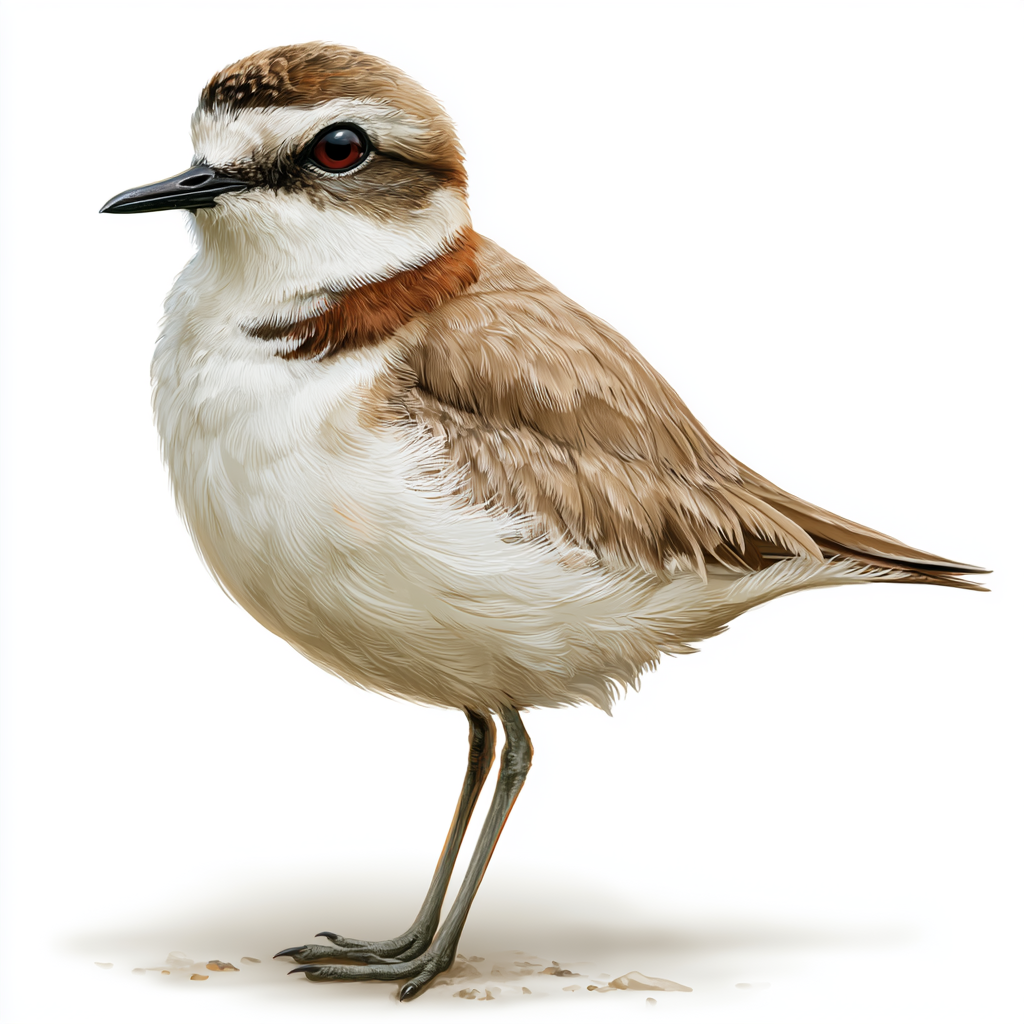
The Kentish Plover can be identified by its pale plumage, dark legs, and dark bill, as well as the male's distinctive dark incomplete breast bands and dark markings on either side of its head. Its grey/brown back and white underside are also notable features.
The Kentish Plover is smaller than a Starling, measuring approximately 18-20 cm in length.
The male Kentish Plover has a pale plumage with a grey/brown back, white underside, and very dark incomplete breast bands, as well as dark markings on either side of its head.
The female Kentish Plover has a similar plumage to the male, but lacks the dark incomplete breast bands and dark head markings, instead having a more subdued colouration.
The Kentish Plover's call is a sharp, high-pitched "tu-tu-tu" or "wit-wit-wit" sound, often repeated in a series.
The Kentish Plover is a ground-nesting bird that feeds on small invertebrates, such as insects and crustaceans, by running and stopping on sandy or muddy shores, and has a swift and direct flight style.
The Kentish Plover can be confused with the Ringed Plover, but can be distinguished by its darker legs and lack of a complete breast band, as well as its more subdued colouration.
Quick Facts
Who's spotted this?
Loading...
Recent community sightings
Loading recent sightings...