Sabine’s Gull
Xema sabini
Sabine's Gull is a rare but exciting visitor to Britain, typically seen during the autumn months when it can be spotted off the eastern and western coasts, particularly during strong winds or after storms. It is a small gull that breeds in the Arctic tundra, making its appearances in Britain a notable event for birdwatchers.
Field Identification Guide
Use these features to identify Sabine’s Gull in the field.
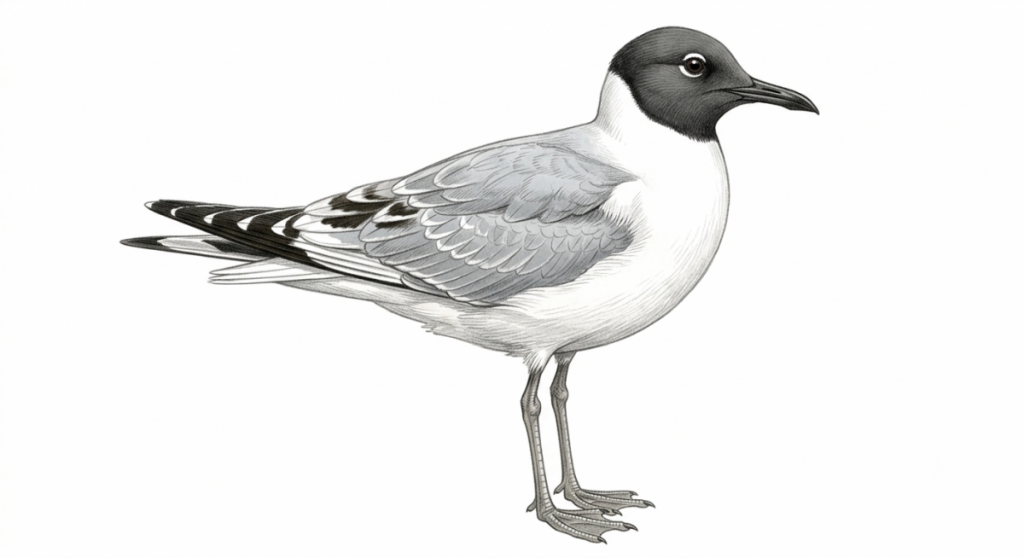
The Sabine's Gull can be identified by its distinctive forked tail, grey nape, and wing pattern featuring a dark tip and a white wedge on the outer primaries. Its small size and slender build also help distinguish it from other gull species.
The Sabine's Gull is smaller than a Black-headed Gull, with a more slender build, making it a diminutive but striking presence among other gull species.
The male Sabine's Gull has a grey back and wings, with a white belly and a black hood that extends to the back of the neck, giving it a distinctive appearance during the breeding season.
The female Sabine's Gull is similar to the male, with no significant differences in plumage, making it challenging to distinguish between the sexes based on appearance alone.
The Sabine's Gull has a high-pitched, nasal call that sounds like a sharp "kee-kee-kee" or a plaintive "kyek-kyek-kyek", often used for contact and alarm.
Sabine's Gulls are pelagic birds that feed on a wide variety of small prey, including fish, crustaceans, and insects, often picking them up from the surface of the water while in flight or swimming. They are agile flyers, capable of quick turns and dives in pursuit of food.
The Sabine's Gull can be confused with the Little Gull, but it can be distinguished by its forked tail and the white wedge on its outer primaries, as well as its more slender build and different head pattern.
Quick Facts
Who's spotted this?
Loading...
Recent community sightings
Loading recent sightings...