Killdeer
Charadrius vociferus
The Killdeer is a rare migrant to Britain, typically seen during the spring and autumn, with most sightings occurring in the southern and western regions. It is a large plover that can be spotted in a variety of habitats, including coastal areas, wetlands, and fields.
Field Identification Guide
Use these features to identify Killdeer in the field.
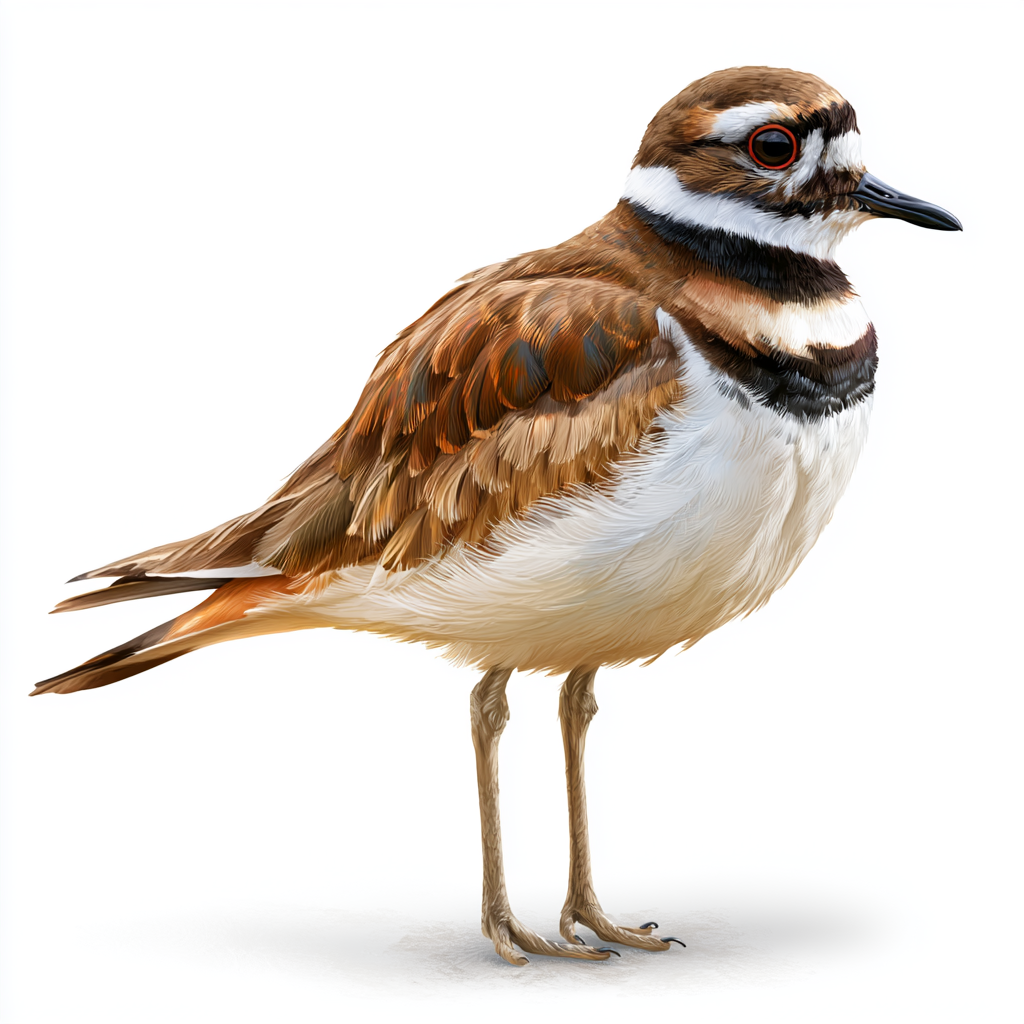
The Killdeer can be identified by its brown upperparts with rufous fringes, white and black patches on the head, and two distinctive black bands crossing the breast. Its white belly and breast, along with its long legs and tail, also help to distinguish it from other species.
The Killdeer is larger than a Lapwing, with a length of around 23-26 cm, making it a medium-sized wader.
The male Killdeer has a distinctive plumage pattern, featuring brown upperparts with rufous fringes, a white and black head, and two black bands crossing the breast, with a white belly and breast.
The female Killdeer is similar to the male, with no significant differences in plumage pattern or colouration.
The Killdeer's call is a loud, shrill, two-syllable sound, often transcribed as "kill-deer", which is frequently heard, especially during the breeding season.
Killdeers are ground-nesting birds that feed on a variety of invertebrates, including insects, worms, and crustaceans, often running or standing still to catch their prey, and are known for their loud, distracting calls when threatened or during courtship.
The Killdeer can be confused with other large plovers, such as the Grey Plover, but can be distinguished by its distinctive black breast bands and rufous-fringed upperparts, as well as its loud, shrill call.
Quick Facts
Who's spotted this?
Loading...
Recent community sightings
Loading recent sightings...