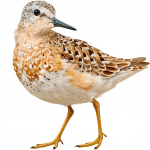
Little Swift
Apus affinis
The Little Swift is a rare vagrant to Britain, with occasional sightings typically in the southern regions during the summer months, often in urban areas or near rocky cliffs. It is more commonly found in Africa and southwestern Asia, where it breeds and can be seen throughout the year.
Field Identification Guide
Use these features to identify Little Swift in the field.
The Little Swift can be identified by its compact body, long, narrow wings, and a distinctive white throat patch, as well as its dark brown back and wings with a pale edge to the feathers. Its forked tail is also a key feature, although it can appear square-ended when folded.
The Little Swift is smaller than a Starling, measuring around 10-12 cm in length, making it one of the smallest birds in the Apodiformes order.
The male Little Swift has a dark brown plumage with a pale grey-brown forehead and a white throat patch, with a slight sheen to the feathers in certain lighting conditions, and its appearance remains relatively consistent throughout the year.
The female Little Swift is similar to the male, with no significant differences in plumage, making it challenging to distinguish between the sexes based on appearance alone.
The Little Swift's call is a high-pitched, shrill "chip-chip-chip" or "swee-swee-swee", often heard when the bird is in flight or near its nesting site.
The Little Swift is an agile and swift flyer, feeding on small insects in mid-air, and can often be seen flying low over urban areas or near cliffs, where it breeds and roosts in colonies, frequently entering and exiting its nesting sites with rapid, darting movements.
The Little Swift can be confused with other swift species, such as the Common Swift or the White-rumped Swift, but can be distinguished by its smaller size, darker plumage, and distinctive white throat patch, as well as its more compact body and narrower wings.
Quick Facts
Who's spotted this?
Loading...
Recent community sightings
Loading recent sightings...