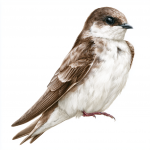
Long-tailed Tit
Aegithalos caudatus
The Long-tailed Tit is a common and widespread species in Britain, typically seen in woodlands, scrublands, and gardens throughout the year, with its distinctive long tail and acrobatic movements making it a notable sight. It can be found in a variety of habitats, including deciduous and mixed woodlands, heathland, and farmland.
Field Identification Guide
Use these features to identify Long-tailed Tit in the field.
The Long-tailed Tit can be identified at a glance by its black and white plumage, long tail, and white and pink colouration on its head and body, with a distinctive black stripe above its beak. Its white head and dark eyebrows are also key distinguishing features, although northern subspecies have completely white heads.
The Long-tailed Tit is smaller than a Starling, measuring around 12-14 cm in length, including its long tail, which is longer than its body.
The male Long-tailed Tit has a predominantly black and white plumage with varying amounts of pink and grey, and a white head with a black stripe above its beak, with some seasonal variation in the intensity of its colours.
The female Long-tailed Tit has similar plumage to the male, with the same black and white colouration and white head, although some females may have slightly less intense pink colouration.
The Long-tailed Tit has a high-pitched, repetitive call that sounds like a series of sharp "tee-tee-tee" notes, often given in a rapid sequence, and a softer, more melodic song that is typically heard during the breeding season.
The Long-tailed Tit is a social and agile bird that forages for insects and spiders in trees and shrubs, often hanging upside down from branches or flying between them in a rapid, darting motion, and is known to form compact family flocks outside of the breeding season.
The Long-tailed Tit can be confused with other small, black-and-white birds such as the Coal Tit or the Marsh Tit, but can be distinguished by its long tail, white head, and distinctive black stripe above its beak, as well as its social and acrobatic behaviour.
Quick Facts
Who's spotted this?
Loading...
Recent community sightings
Loading recent sightings...