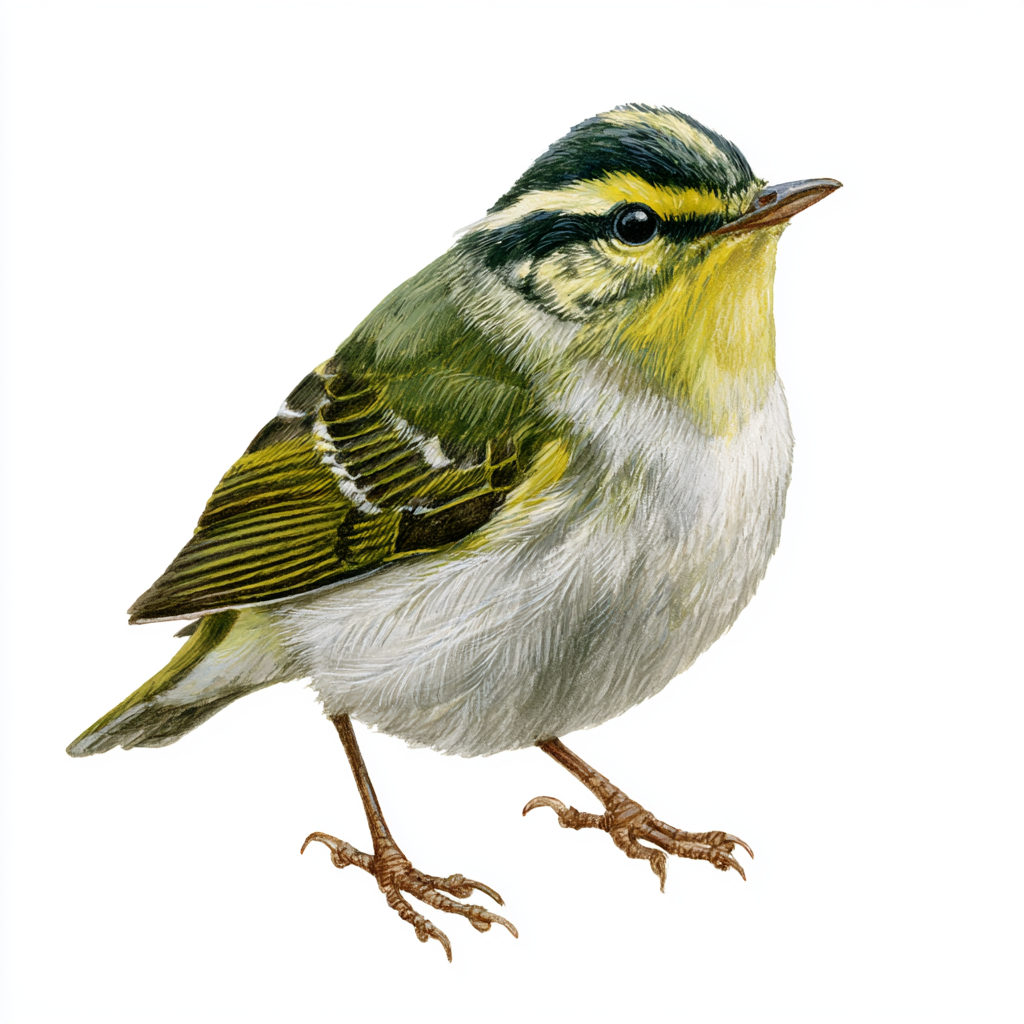
Pallas’s Warbler
Phylloscopus proregulus
Pallas's Warbler is a rare but increasingly seen migrant in Britain, typically spotted in autumn, particularly in the eastern and southern regions, often in woodland edges and scrubby areas. It is a notable sighting due to its origins from mountain forests in southern Siberia and eastern Asia.
Field Identification Guide
Use these features to identify Pallas’s Warbler in the field.
At a glance, Pallas's Warbler can be identified by its distinctive yellow crown stripe, white eye-ring, and pale yellowish-green upperparts, which distinguish it from other warblers.
The Pallas's Warbler is slightly smaller than a Chiffchaff, making it a compact and agile bird.
The male Pallas's Warbler has a bright yellow crown stripe, pale yellowish-green upperparts, and whitish underparts, with a subtle yellow tint on the breast and flanks, which can vary slightly depending on the season.
The female Pallas's Warbler is similar to the male, with slightly duller colours, but retains the distinctive yellow crown stripe and white eye-ring.
The call of the Pallas's Warbler is a sharp, high-pitched "tseep" or "tsit", often repeated in a series, while its song is a melodic, whistled phrase, typically heard during the breeding season.
Pallas's Warblers are active, agile birds that forage for insects and spiders in dense vegetation, often flitting between branches and making short, darting flights, and can be seen hovering in front of foliage to catch prey.
Pallas's Warbler can be confused with other leaf warblers, such as the Yellow-browed Warbler, but can be distinguished by its brighter yellow crown stripe, white eye-ring, and paler upperparts, as well as its distinctive call and song.
Quick Facts
Who's spotted this?
Loading...
Recent community sightings
Loading recent sightings...


