Parrot Crossbill
Loxia pytyopsittacus
The Parrot Crossbill is a rare and irregular visitor to Britain, typically seen in coniferous woodlands, particularly during irruptions when food is scarce on the continent. It is most likely to be spotted in the north and east of the country, especially during the winter months.
Field Identification Guide
Use these features to identify Parrot Crossbill in the field.
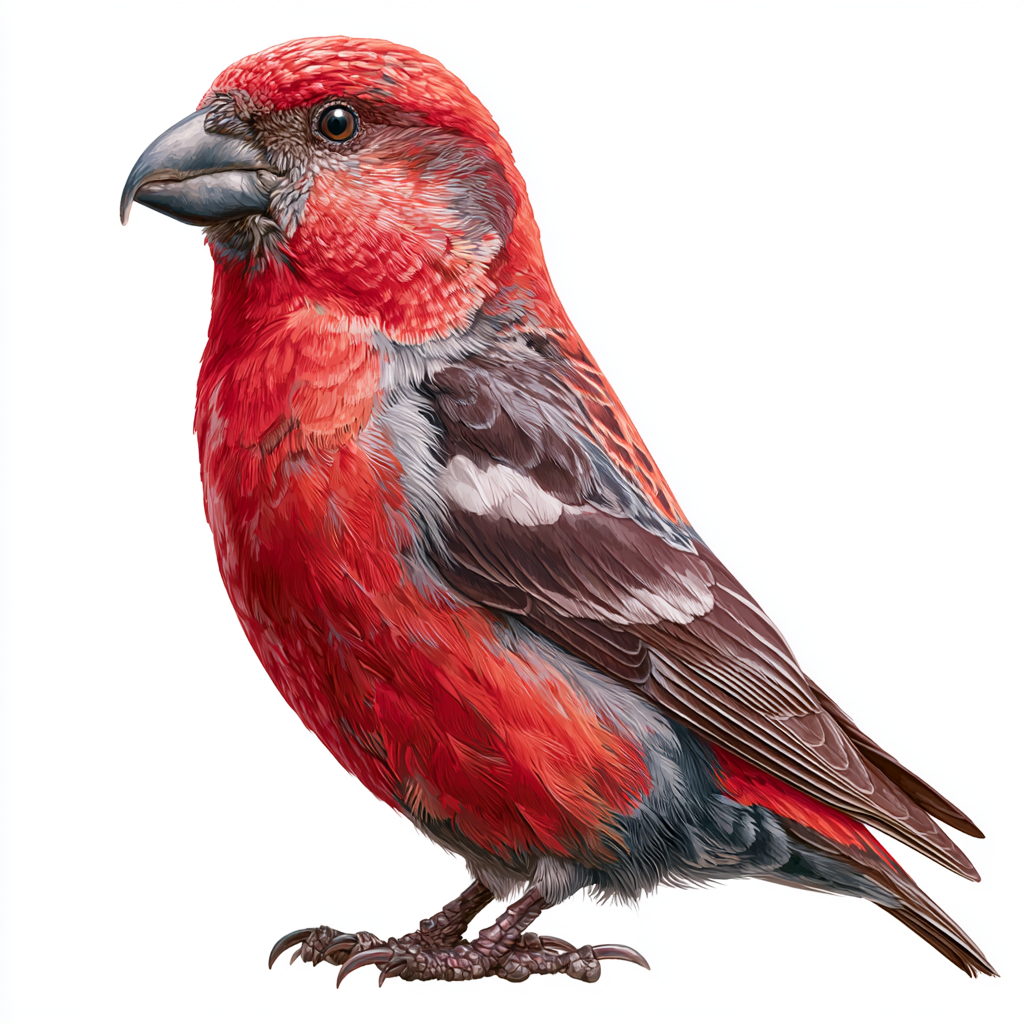
The Parrot Crossbill can be identified by its distinctive crossed bill, bright red to orange-red plumage, and white wing bars. Its head and breast are also notable for their deep red colour, with a brownish tint to the back and wings.
The Parrot Crossbill is slightly smaller than a Starling, with a more compact body.
The male Parrot Crossbill has a vibrant red to orange-red plumage, with a deep red head and breast, and a brownish back and wings, although the exact shade can vary depending on the subspecies and the time of year.
The female Parrot Crossbill is similar to the male but with a more subdued yellow-green plumage, particularly on the head, breast, and rump, although some females can have a reddish tint.
The Parrot Crossbill has a distinctive call that sounds like a sharp, metallic "chip-chip-chip" or a series of descending whistles.
The Parrot Crossbill is a social bird that forages for seeds, particularly conifer seeds, in the upper canopy of trees, often hanging upside down to extract seeds from cones, and flying in a swift, direct manner between trees.
The Parrot Crossbill can be confused with the Common Crossbill, but it is distinguished by its brighter, more vibrant plumage and a more pronounced crossed bill, as well as its larger size and more rounded wing tips.
Quick Facts
Who's spotted this?
Loading...
Recent community sightings
Loading recent sightings...