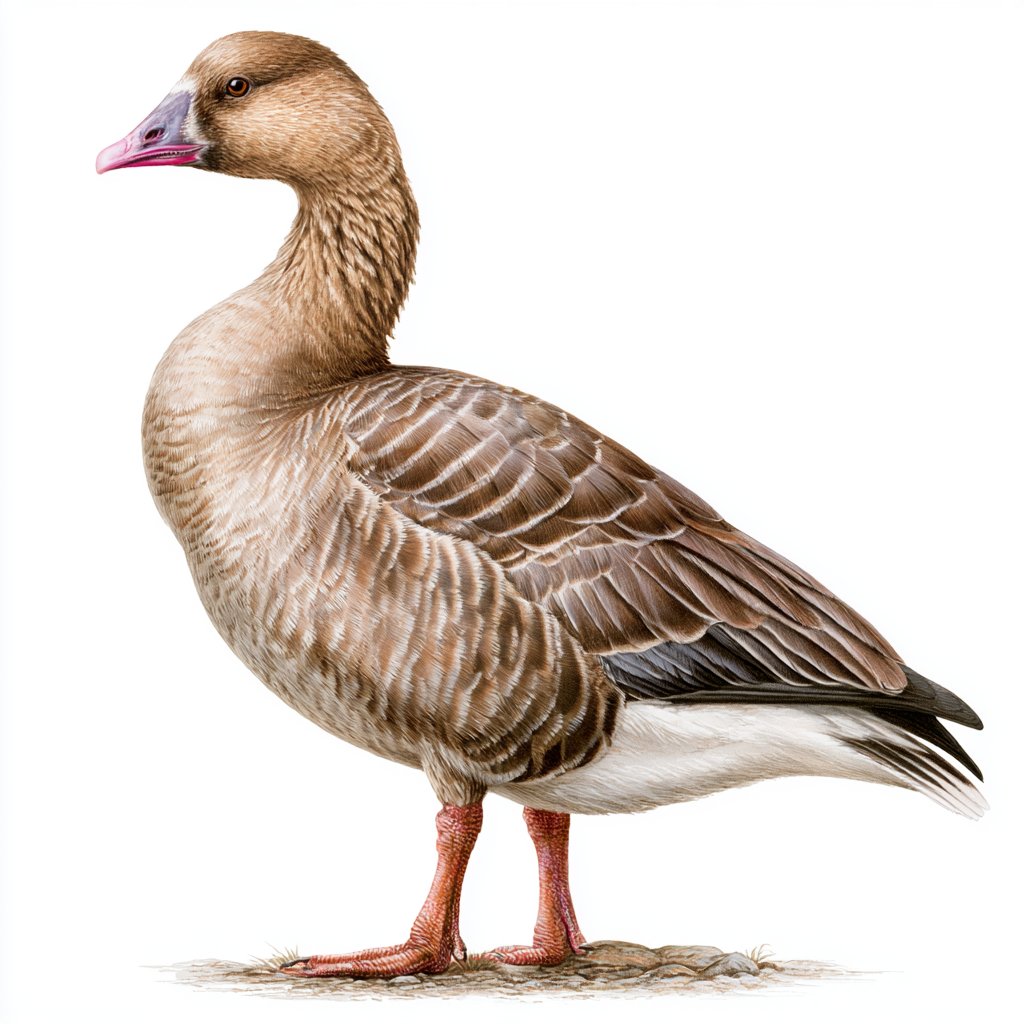
Pink-footed Goose
Anser brachyrhynchus
The Pink-footed Goose is a notable winter visitor to Britain, particularly in northwest Europe, with large flocks often seen in Ireland, Great Britain, and the Netherlands from September to April. In Britain, they can be seen in wetlands, coastal areas, and farmland, especially in eastern and northern England.
Field Identification Guide
Use these features to identify Pink-footed Goose in the field.
At a glance, the Pink-footed Goose can be identified by its pink feet and legs, dark brown head and neck, and pale grey-brown body, with a distinctive white patch on the forehead and a short, black bill. Its grey-brown plumage and pink feet distinguish it from other goose species.
The Pink-footed Goose is slightly smaller than a Greylag Goose, but larger than a Mallard, with a length of around 60-75 cm.
The male Pink-footed Goose has a dark brown head and neck, pale grey-brown body, and white patches on the forehead and underside of the tail, with no significant seasonal variation in plumage.
The female Pink-footed Goose is similar to the male, with the same plumage pattern and colours, although she may be slightly duller in appearance.
The Pink-footed Goose has a high-pitched, yelping call, often transcribed as "wink-wink" or "ahnk-ahnk", which is usually heard in flight or when the birds are alarmed.
Pink-footed Geese are grazing birds, feeding on grasses, leaves, and crops in fields and wetlands, and they are often seen in large flocks, flying in V-formation during migration.
The Pink-footed Goose can be confused with the Greylag Goose or the White-fronted Goose, but it can be distinguished by its pink feet and legs, darker head and neck, and shorter bill, as well as its more slender neck and smaller size.
Quick Facts
Who's spotted this?
Loading...
Recent community sightings
Loading recent sightings...


