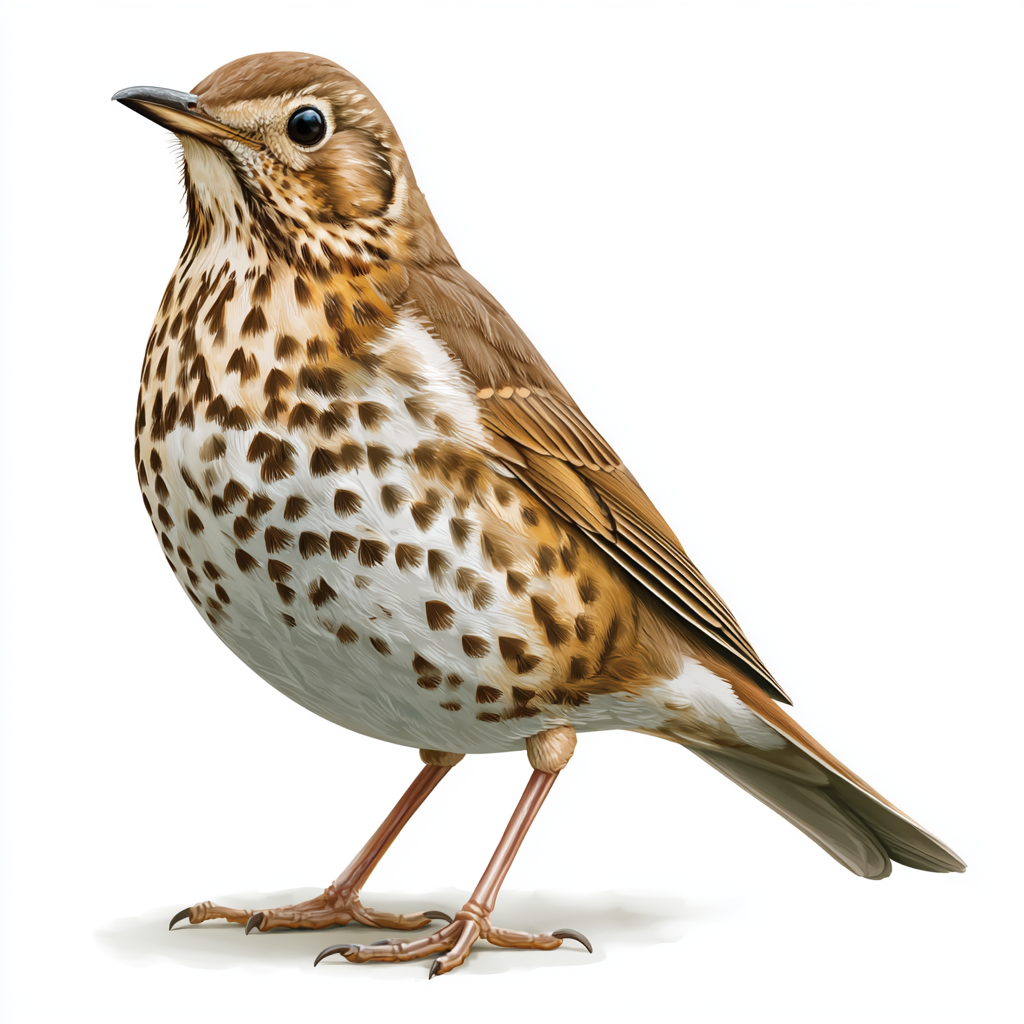
Song Thrush
Turdus philomelos
The Song Thrush is a common and widespread breeding bird in Britain, typically seen in woodlands, gardens, and parks from March to October, with some individuals remaining in the country throughout the year. It is a migratory species, with many birds wintering in southern Europe and North Africa.
Field Identification Guide
Use these features to identify Song Thrush in the field.
The Song Thrush can be identified by its brown upperparts, black-spotted cream or buff underparts, and distinctive white eye-ring, which sets it apart from other thrush species. Its rounded body shape and long, reddish-brown legs are also notable features.
The Song Thrush is slightly smaller than a Blackbird, but larger than a Robin, making it a medium-sized bird that is easily recognizable in the field.
The male Song Thrush has a warm, brown back and wings, with a creamy or buff-colored breast and belly covered in distinctive black spots, which can vary in intensity and density depending on the subspecies.
The female Song Thrush is similar to the male in terms of plumage, with the same brown upperparts and spotted underparts, although the spotting may be slightly less intense in some individuals.
The Song Thrush has a melodious and repetitive song, featuring a series of musical phrases that are often repeated and varied, with a distinctive, flute-like quality that is one of the most recognizable bird songs in Britain.
Song Thrushes are ground-foraging birds that feed on a wide range of invertebrates, fruits, and berries, often using their strong, pointed beaks to probe into soil and leaf litter in search of food, and are known for their bold and curious nature.
The Song Thrush can be confused with the Redwing or the Blackbird, but can be distinguished from these species by its spotted underparts, white eye-ring, and distinctive song, as well as its more reddish-brown legs and warmer, more brownish upperparts.
Quick Facts
Who's spotted this?
Loading...
Recent community sightings
Loading recent sightings...


