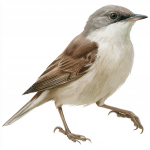
Rock Pipit
Anthus petrosus
The Rock Pipit is a common sight in Britain's coastal areas, particularly on rocky shores and beaches, and can be seen throughout the year, although some populations may migrate to southern Europe during the winter months. It is a year-round resident in the UK, with breeding activity peaking during the spring and summer.
Field Identification Guide
Use these features to identify Rock Pipit in the field.
The Rock Pipit can be identified by its streaked greyish-brown upperparts, buff underparts, and distinctive white outer tail feathers, which are visible when the bird is in flight. Its legs are also a notable feature, being long and pinkish-brown in colour.
The Rock Pipit is slightly smaller than a Starling, measuring around 16-18 cm in length, and is larger than a Blue Tit.
The male Rock Pipit has streaked greyish-brown upperparts and buff underparts, with a distinctive black stripe above its eye and a white stripe above its eyebrow, and its plumage remains relatively consistent throughout the year.
The female Rock Pipit is similar to the male in terms of plumage, with the same streaked greyish-brown upperparts and buff underparts, although it may appear slightly duller in colour.
The Rock Pipit's call is a sharp, high-pitched "tzee" or "tee-zee" sound, often repeated in a series, while its song is a melodic, whistled phrase that is typically sung from a rocky outcrop or beach.
Rock Pipits are ground-dwelling birds that feed on small invertebrates, such as insects and crustaceans, which they forage for among rocks and beach debris, and they are known to be territorial, with males defending their territories against intruders.
The Rock Pipit can be confused with other pipit species, such as the Meadow Pipit, but can be distinguished by its more streaked upperparts, longer legs, and distinctive white outer tail feathers, as well as its preference for rocky coastal habitats.
Quick Facts
Who's spotted this?
Loading...
Recent community sightings
Loading recent sightings...