Lesser Whitethroat
Curruca curruca
The Lesser Whitethroat is a migratory warbler that can be seen in Britain during the summer months, typically from April to October, with a preference for dense, scrubby habitats and woodland edges. It is a relatively common breeding bird in southern and eastern England, but less frequent in the north and west.
Field Identification Guide
Use these features to identify Lesser Whitethroat in the field.
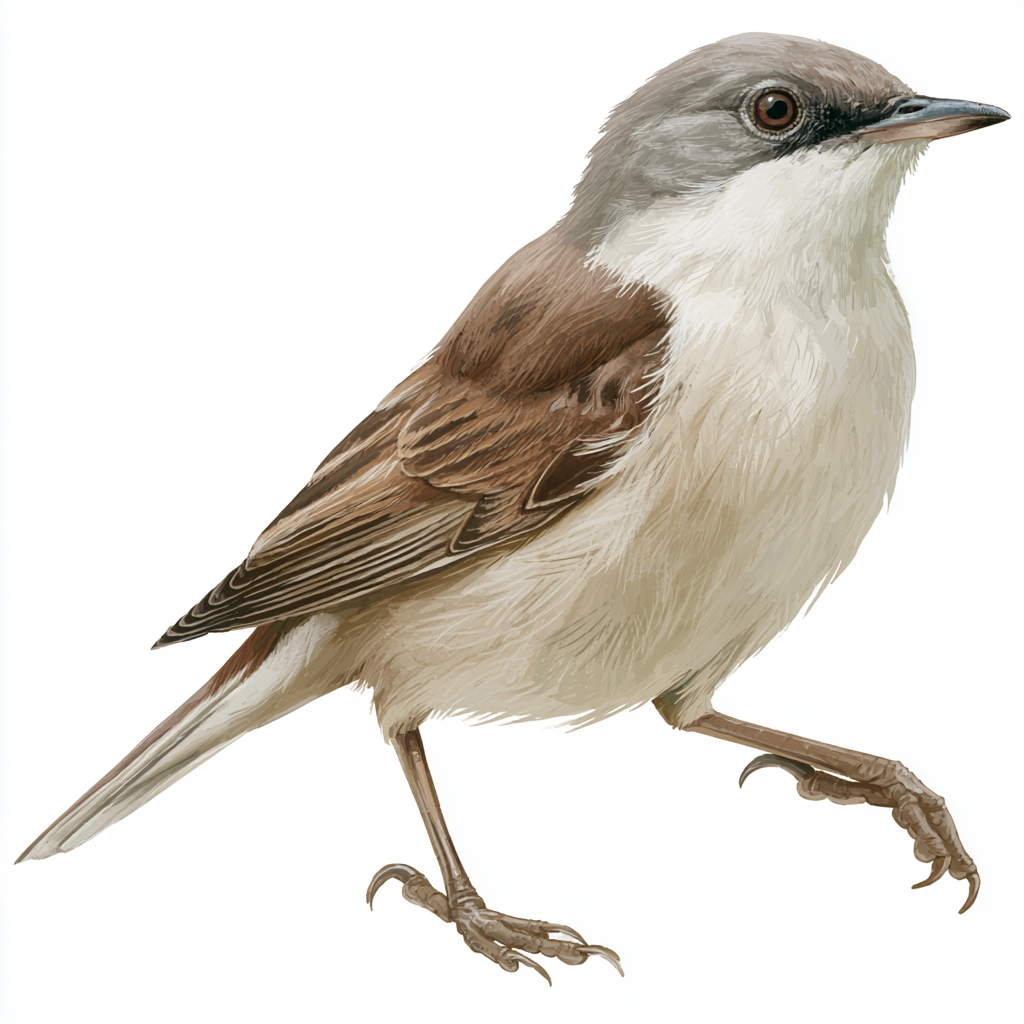
The Lesser Whitethroat can be identified by its greyish-brown back, white throat patch, and distinctive white eye-ring, as well as its relatively small size and long, pointed tail. Its wings and tail are also edged with a pale fringe, giving a subtly striped appearance.
The Lesser Whitethroat is smaller than a Starling, measuring around 11-12 cm in length, and is roughly the same size as a House Sparrow.
The male Lesser Whitethroat has a greyish-brown back, wings, and tail, with a white throat patch and a pale greyish-white belly, and its plumage remains relatively consistent throughout the year.
The female Lesser Whitethroat is similar to the male, with a slightly duller and more subdued colouration, but overall the sexes are not readily distinguishable by plumage alone.
The Lesser Whitethroat's call is a sharp, scratchy "tak" or "tek" sound, while its song is a series of short, melodic phrases that are often described as hesitant or stuttering.
The Lesser Whitethroat is an active and restless bird, often flitting between dense vegetation and making short, darting flights in pursuit of insects and other small invertebrates, and it will also occasionally hover in mid-air to catch prey.
The Lesser Whitethroat can be confused with the Whitethroat, but can be distinguished by its greyish-brown back, white eye-ring, and more subdued colouration, as well as its smaller size and more pointed tail.
Quick Facts
Who's spotted this?
Loading...
Recent community sightings
Loading recent sightings...