Roseate Tern
Sterna dougallii
The Roseate Tern is a rare but striking summer visitor to Britain, typically seen in coastal areas, particularly in the west and northwest, from May to September. It is most commonly spotted in colonies on rocky islands and coastal headlands.
Field Identification Guide
Use these features to identify Roseate Tern in the field.
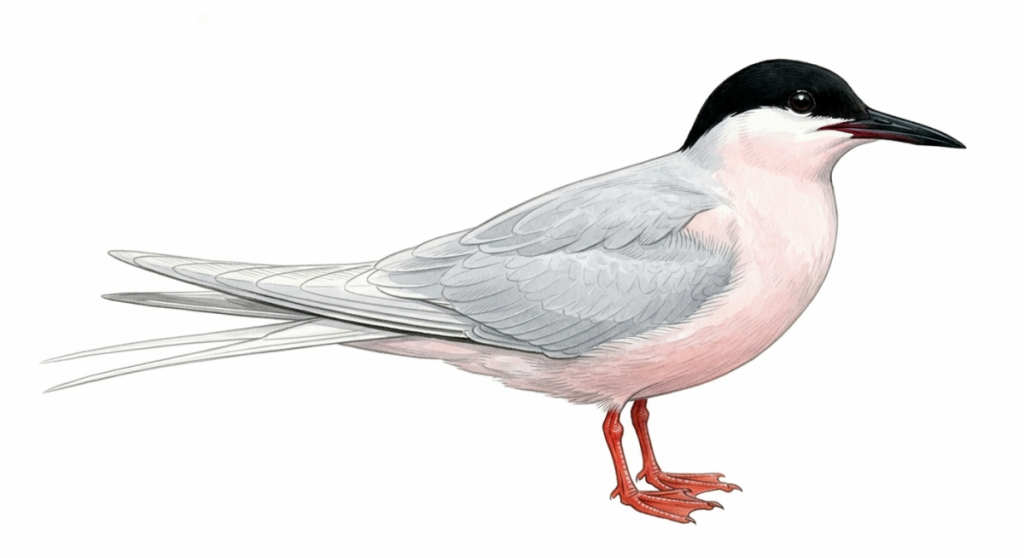
The Roseate Tern can be identified by its pale grey back, white forehead, and distinctive pink breast, as well as its long, thin bill and forked tail. Its black cap and white cheeks are also notable features.
The Roseate Tern is slightly smaller than a Common Tern, with a more slender build.
The male Roseate Tern has a pale grey back, white forehead, and a bright pink breast, with a black cap and white cheeks, during the breeding season, with the pink colouration fading to a more subdued tone outside of breeding.
The female Roseate Tern is similar to the male, with the same overall pattern and colouration, although the pink breast may be slightly less intense.
The Roseate Tern's call is a sharp, high-pitched "kee-kee-kee" or "kirr-kirr-kirr", often repeated in a series.
Roseate Terns are agile and swift fliers, feeding on small fish and crustaceans in coastal waters, often diving from a height to catch their prey, and are known for their noisy and social colonies.
The Roseate Tern can be confused with the Common Tern, but can be distinguished by its pale grey back, longer bill, and distinctive pink breast, as well as its more slender build and forked tail.
Quick Facts
Who's spotted this?
Loading...
Recent community sightings
Loading recent sightings...