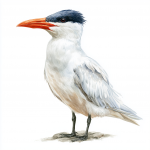
Sociable Lapwing
Vanellus gregarius
The Sociable Lapwing is a rare migrant to Britain, with most sightings occurring during the spring and autumn migration periods, particularly in the eastern and southern regions. It is a distinctive wader that can be seen in a variety of habitats, including wetlands, grasslands, and coastal areas.
Field Identification Guide
Use these features to identify Sociable Lapwing in the field.
The Sociable Lapwing can be identified by its distinctive black belly, white forehead, and brown upperparts, as well as its long, black legs and straight, black bill. Its broad, rounded wings and long tail are also notable features.
The Sociable Lapwing is slightly larger than a Golden Plover, with a length of around 28-30 cm.
The male Sociable Lapwing has a distinctive black belly, white forehead, and brown upperparts, with a white stripe above the eye and a black crown.
The female Sociable Lapwing is similar to the male, with no significant differences in plumage.
The Sociable Lapwing has a sharp, metallic call, often transcribed as "pee-pee-pee" or "chu-chu-chu", which is frequently heard during migration and breeding.
Sociable Lapwings are social birds that often feed in flocks, probing the ground for insects, worms, and other small invertebrates with their straight bills. They have a swift, direct flight style and are known for their migratory habits.
The Sociable Lapwing can be confused with other lapwing species, such as the Northern Lapwing, but can be distinguished by its black belly, white forehead, and distinctive call.
Quick Facts
Who's spotted this?
Loading...
Recent community sightings
Loading recent sightings...