Stonechat
Saxicola rubicola
The Stonechat is a notable species in Britain, typically seen in open scrubland and grassland with scattered small shrubs, particularly in the southern and western regions, with sightings more common during the breeding season. It is a partial migrant, with some populations remaining in Britain year-round, while others migrate to Africa and southern Europe.
Field Identification Guide
Use these features to identify Stonechat in the field.
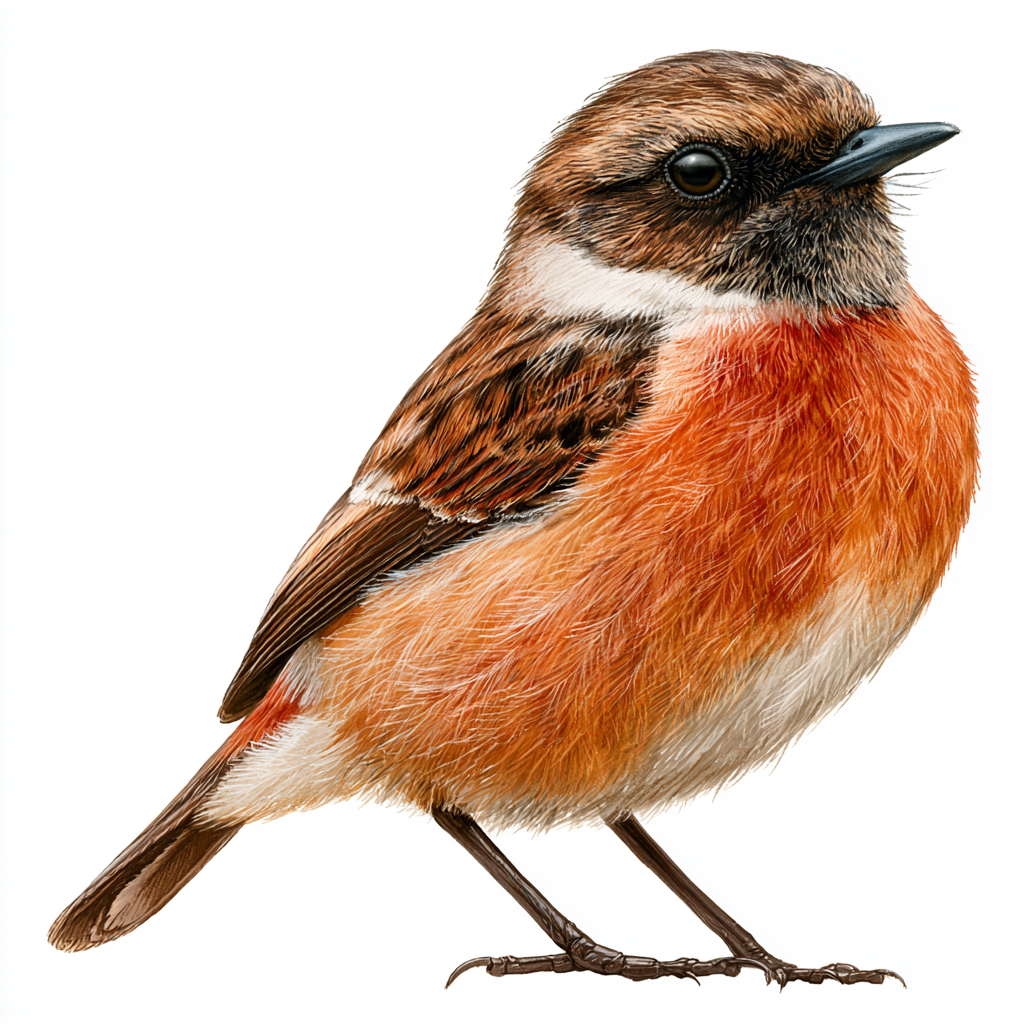
The Stonechat can be identified at a glance by its distinctive black head with a white half-collar, orange-chestnut breast, and white belly, as well as its upright posture and long tail. Its dark brown back and wings also help to distinguish it from other similar species.
The Stonechat is smaller than a Starling, measuring around 11-12 cm in length, and is larger than a Blue Tit.
The male Stonechat has a black head, white half-collar, and orange-chestnut breast, with a dark brown back and wings, and a white belly, with little seasonal variation in its plumage.
The female Stonechat has similar plumage to the male, but with a brown head and less intense orange-chestnut breast, and a more subdued overall colouration.
The Stonechat's call is a sharp, metallic "tak" or "chat" sound, while its song is a series of short, melodic phrases often described as a repetitive, whistled tune.
The Stonechat is an insectivorous species, feeding on a variety of insects and spiders, and can be seen flying low over the ground in search of prey, with a distinctive, fluttering flight style and a habit of perching upright on top of shrubs and trees.
The Stonechat can be confused with the Whinchat, but can be distinguished by its black head with a white half-collar, and its more intense orange-chestnut breast, as well as its darker back and wings.
Quick Facts
Who's spotted this?
Loading...
Recent community sightings
Loading recent sightings...