Nightingale
Luscinia megarhynchos
The Nightingale is a rare but sought-after migrant in Britain, typically seen in the southern counties during its spring and autumn migrations, with a few individuals remaining to breed in the UK's warmer regions. It is most often encountered in dense, scrubby habitats with thick undergrowth, where its beautiful song can be heard.
Field Identification Guide
Use these features to identify Nightingale in the field.
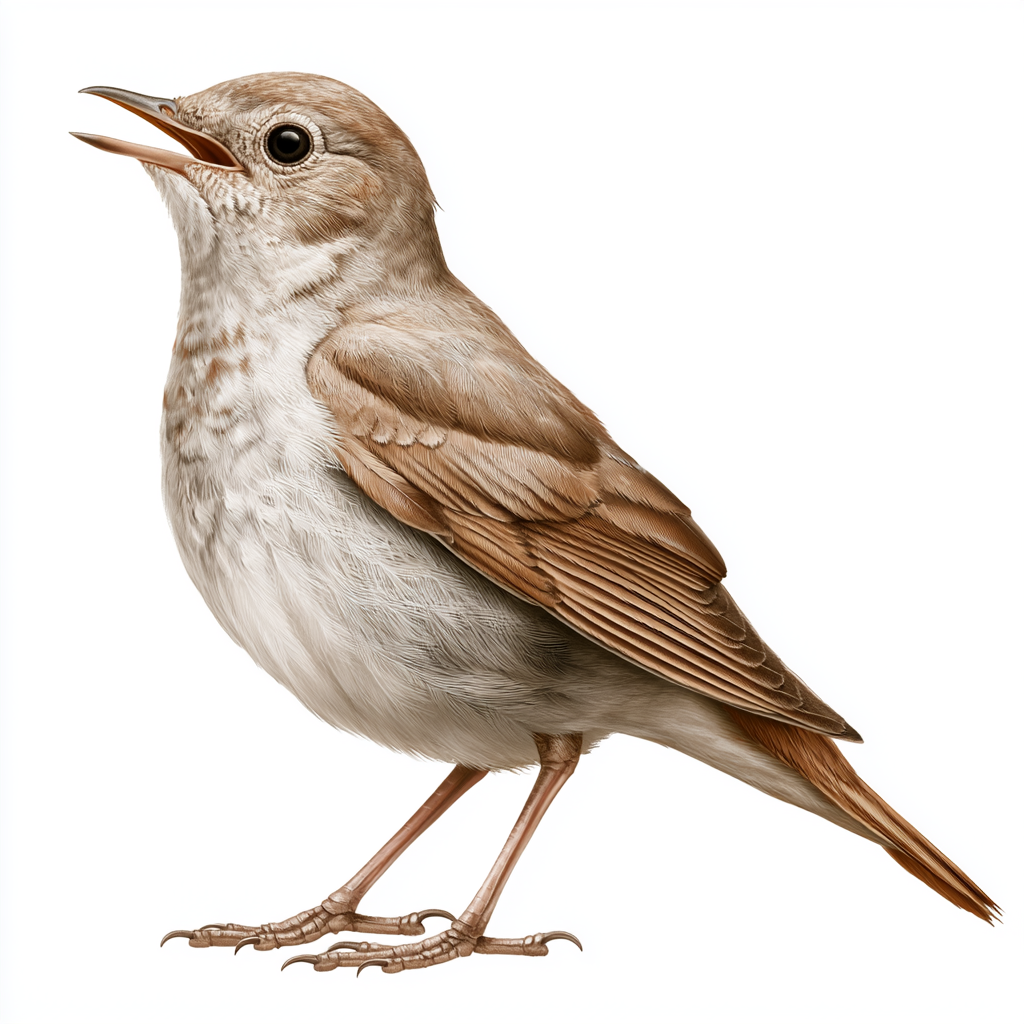
The Nightingale can be identified by its reddish-brown plumage, white underside with dark spots, and distinctive white eye-ring, as well as its relatively long tail and short, rounded wings.
The Nightingale is slightly smaller than a Robin, but larger than a Blue Tit.
The male Nightingale has a reddish-brown back and wings, with a white underside featuring dark spots, and a greyish-brown head with a distinctive white eye-ring, with little seasonal variation in its plumage.
The female Nightingale is similar to the male, with slightly duller colours and a more subdued pattern, but overall the sexes are alike.
The Nightingale's song is a powerful, melodious, and highly varied series of whistles, trills, and chirps, often described as one of the most beautiful sounds in nature.
Nightingales are ground-dwelling birds that feed on insects, spiders, and small invertebrates, often foraging in dense undergrowth, and when in flight, they have a rapid, darting style with short, rounded wings.
The Nightingale can be confused with the Thrush Nightingale, but can be distinguished by its more reddish-brown plumage, white eye-ring, and shorter, more rounded wings, as well as its distinctive song.
Quick Facts
Who's spotted this?
Loading...
Recent community sightings
Loading recent sightings...