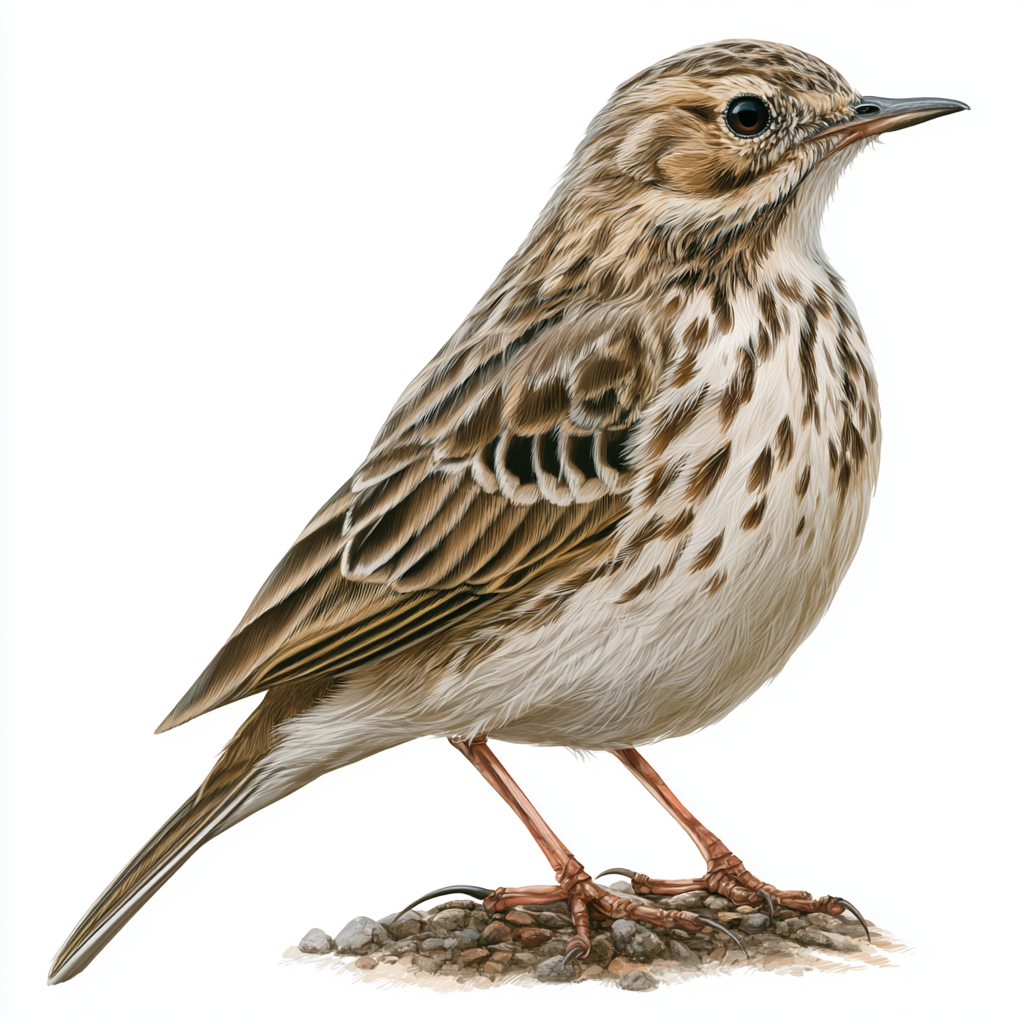
Tree Pipit
Anthus trivialis
The Tree Pipit is a summer migrant to Britain, typically seen in open woodland edges and heathlands from April to October, with the majority of sightings occurring in southern and eastern England. It is a relatively scarce breeding bird in Britain, with numbers declining in recent years.
Field Identification Guide
Use these features to identify Tree Pipit in the field.
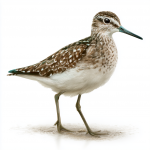
The Tree Pipit can be identified by its streaked breast, pale yellowish-buff underside, and distinctive white outer tail feathers, which are visible in flight. Its brownish-grey back and wings also help to distinguish it from other pipit species.
The Tree Pipit is slightly smaller than a Meadow Pipit, and larger than a Blue Tit, measuring around 12-14 cm in length.
The male Tree Pipit has a brownish-grey back and wings, with a streaked breast and pale yellowish-buff underside, and a distinctive white stripe above its eye, with little seasonal variation in its plumage.
The female Tree Pipit is similar to the male, with the same brownish-grey back and wings, and streaked breast, although it may appear slightly duller in colour.
The Tree Pipit's song is a series of descending phrases, often described as a melancholic, whistled "tee-tee-tee", while its call is a sharp, metallic "tzreep" or "tzeek".
Tree Pipits are ground-foraging birds, feeding on insects and seeds, and can often be seen walking or running on the ground in search of food, with a distinctive bobbing motion as they fly between perches.
The Tree Pipit can be confused with the Meadow Pipit, but can be distinguished by its more streaked breast, and white outer tail feathers, as well as its more slender build and longer legs.
Quick Facts
Who's spotted this?
Loading...
Recent community sightings
Loading recent sightings...