Yellow-bellied Sapsucker
Sphyrapicus varius
The Yellow-bellied Sapsucker is a rare visitor to Britain, with most sightings occurring during autumn and winter, particularly in the eastern and southern regions. It is typically seen in woodland areas, often near coniferous trees, although its appearances are infrequent and usually involve individual birds that have wandered from their North American breeding grounds.
Field Identification Guide
Use these features to identify Yellow-bellied Sapsucker in the field.
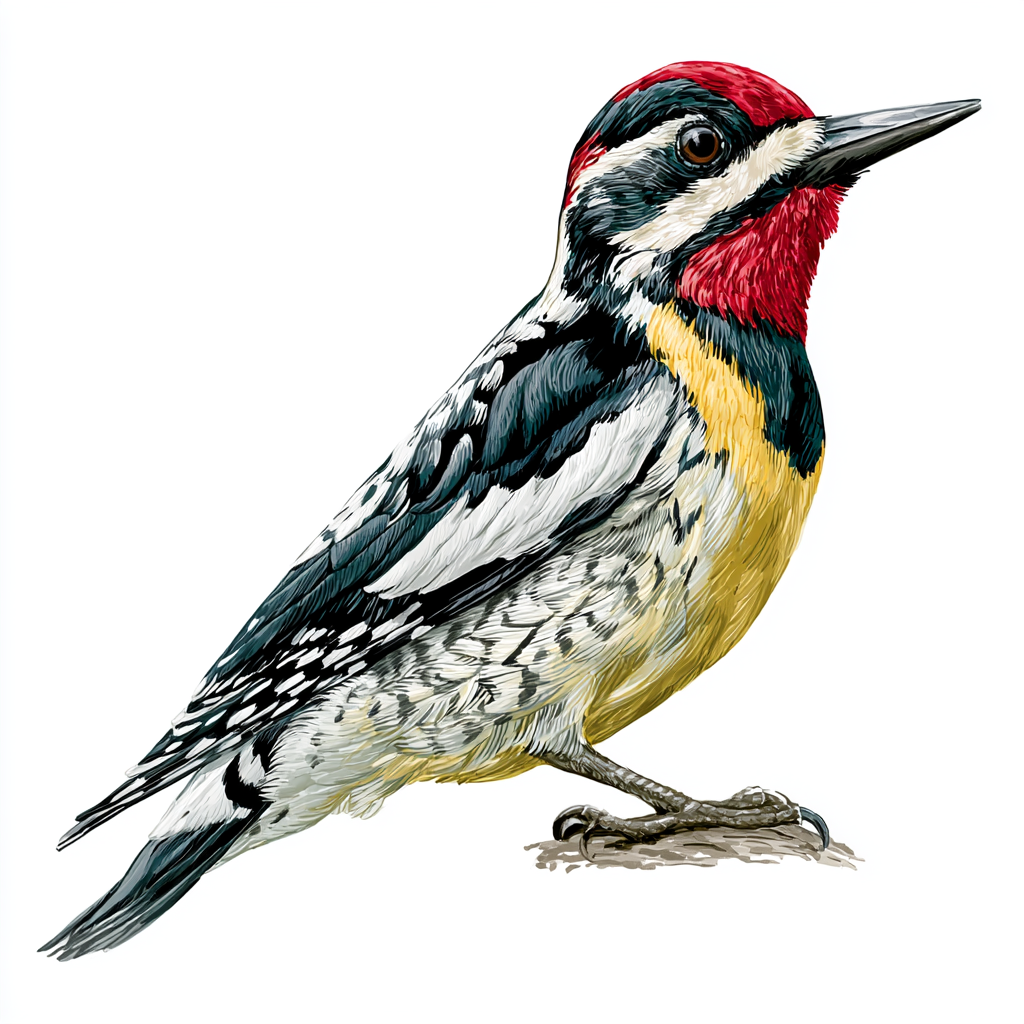
The Yellow-bellied Sapsucker can be identified by its black and white striped back, red cap, and yellow belly, as well as its distinctive white wing patches. Its black bib and white cheeks also help to distinguish it from other woodpeckers.
The Yellow-bellied Sapsucker is slightly larger than a Great Spotted Woodpecker, but smaller than a Green Woodpecker.
The male Yellow-bellied Sapsucker has a red cap on top of its head, a black bib, and a yellow belly, with black and white striped back and white wing patches.
The female Yellow-bellied Sapsucker is similar to the male, but with a red cap that is often less extensive, and sometimes with a black stripe above the white cheek patch.
The Yellow-bellied Sapsucker's call is a loud, nasal "nek" or "kenk" sound, often repeated in a series.
The Yellow-bellied Sapsucker feeds by excavating sap wells in trees, using its long, extendable tongue to lap up the sap, and also eats insects and fruits, with a slow and deliberate flight style.
The Yellow-bellied Sapsucker can be confused with the Great Spotted Woodpecker, but can be distinguished by its yellow belly, red cap, and black and white striped back, as well as its larger size and different call.
Quick Facts
Who's spotted this?
Loading...
Recent community sightings
Loading recent sightings...