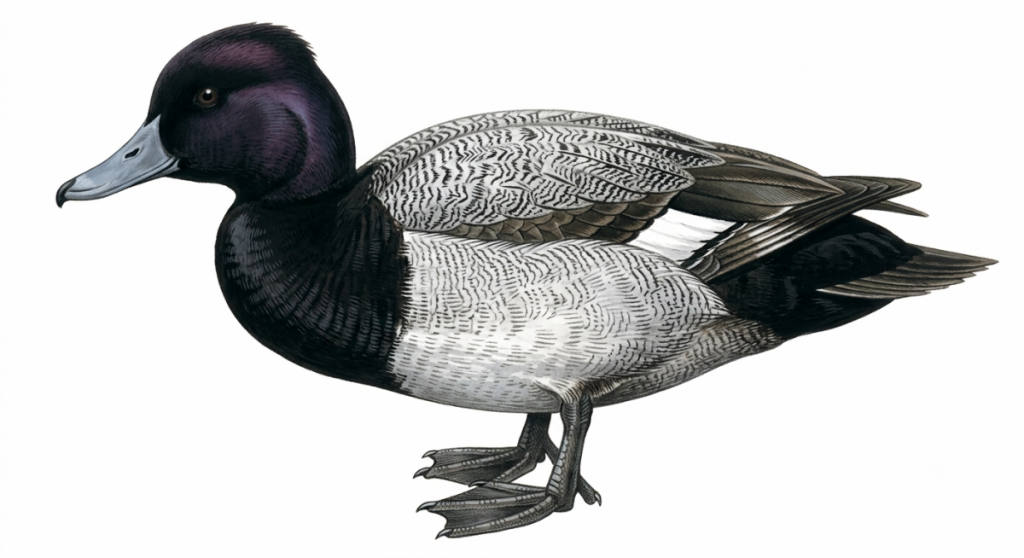
Lesser Scaup
Aythya affinis
The Lesser Scaup is a rare migrant to Britain, typically seen during the winter months, and is most often found on coastal wetlands and estuaries. It is a small North American diving duck that is occasionally blown off course to British shores.
Field Identification Guide
Use these features to identify Lesser Scaup in the field.
The Lesser Scaup can be identified by its distinctive blue-grey bill, rounded head, and lack of a distinctive white wing bar, distinguishing it from other similar species. Its grey back and white underside also help to set it apart.
The Lesser Scaup is smaller than a Tufted Duck, but larger than a Goldeneye, making it a medium-sized diving duck.
The male Lesser Scaup has a glossy black head, grey back, and white underside, with a purple sheen to the head in good light, and its plumage remains relatively consistent throughout the year.
The female Lesser Scaup is similar to the male, but with a brownish-grey head and a less glossy appearance, making it slightly more subdued in its colouration.
The Lesser Scaup's call is a discordant, nasal "scaup" or "kraa", often repeated, and is quite distinctive.
The Lesser Scaup is a diving duck that feeds on aquatic plants, molluscs, and small invertebrates, and can be seen swimming and diving in coastal waters, as well as flying in a rapid, direct manner.
The Lesser Scaup can be confused with the Greater Scaup, but can be distinguished by its smaller size, more rounded head, and lack of a white wing bar, as well as its more subdued female plumage.
Quick Facts
Who's spotted this?
Loading...
Recent community sightings
Loading recent sightings...


