Ring-necked Duck
Aythya collaris
The Ring-necked Duck is a rare but occasional visitor to Britain, typically seen on freshwater ponds and lakes during the winter months or as a vagrant. It is most likely to be spotted in the southern and western regions of the country, particularly in areas with abundant wetland habitats.
Field Identification Guide
Use these features to identify Ring-necked Duck in the field.
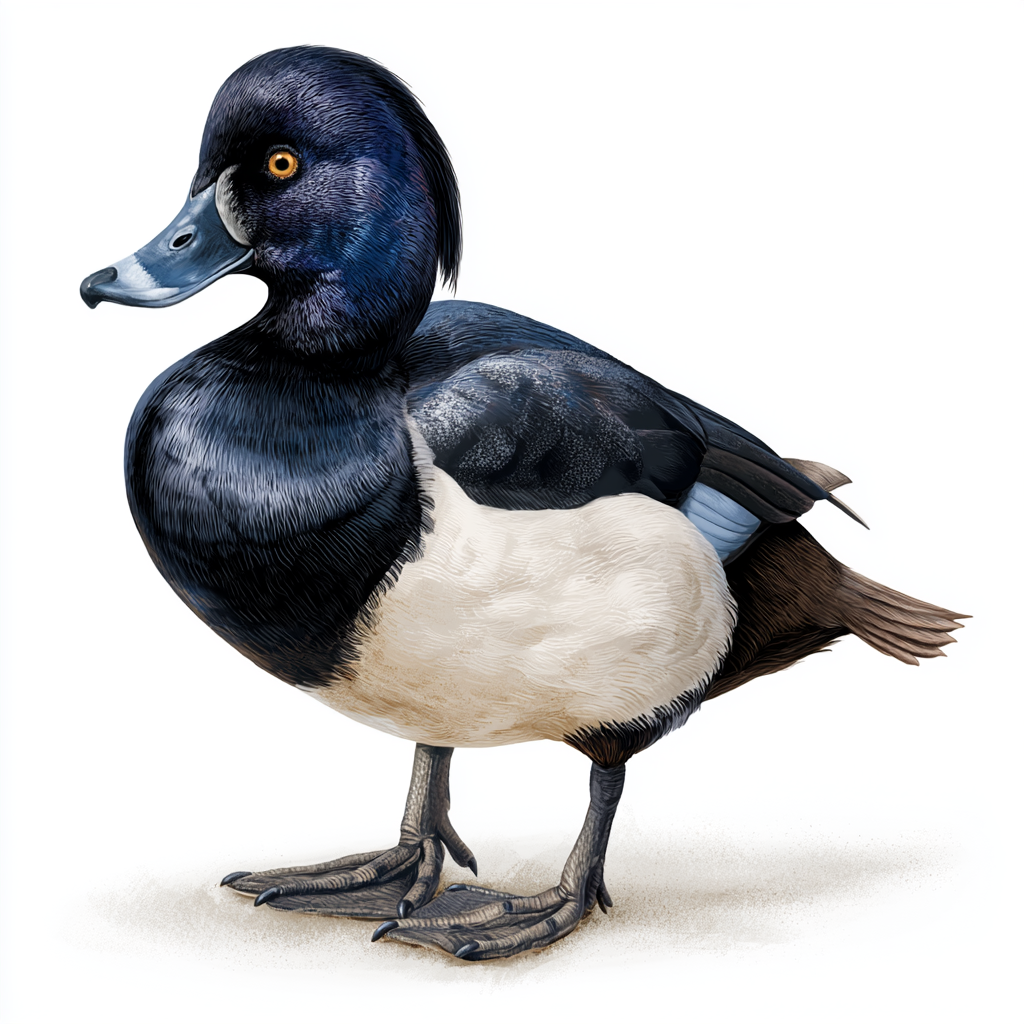
The Ring-necked Duck can be identified by its distinctive black neck ring, grey flanks, and a greyish-blue bill, as well as its overall compact, streamlined shape. Its head and chest are also notable for being a rich, dark brown colour.
The Ring-necked Duck is slightly larger than a Tufted Duck, but smaller than a Pochard, making it a medium-sized diving duck.
The male Ring-necked Duck has a glossy black head, neck, and chest, with a distinctive purple sheen in the right light, and a greyish-blue bill, while its body is a mix of grey and brown hues.
The female Ring-necked Duck is similar to the male but has a browner head and chest, and a less pronounced neck ring, making it slightly more subdued in appearance.
The Ring-necked Duck's call is a soft, nasal "brrr" or "kek", often repeated in a series of short, staccato bursts.
Ring-necked Ducks are diving birds that feed on aquatic plants, insects, and small invertebrates, often swimming with their heads submerged and their tails held high, and they are also known for their rapid, direct flight style.
The Ring-necked Duck can be confused with the Tufted Duck, but can be distinguished by its grey flanks, lack of a tuft, and distinctive neck ring, as well as its more compact shape and different bill colour.
Quick Facts
Who's spotted this?
Loading...
Recent community sightings
Loading recent sightings...