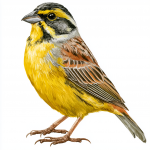
Steller’s Eider
Polysticta stelleri
Steller's Eider is a rare winter visitor to Britain, typically seen in small numbers along the eastern and northern coastlines, particularly in areas with coastal tundra or marshes. It is most likely to be spotted during periods of harsh weather, when individuals may be forced to migrate further south than their usual Arctic habitats.
Field Identification Guide
Use these features to identify Steller’s Eider in the field.
The Steller's Eider can be identified by its distinctive black and white head pattern, yellow bill, and striking white patches on its wings, which are visible in flight. Its compact body and rapid wingbeats also distinguish it from other eider species.
The Steller's Eider is smaller than a Common Eider, roughly comparable in size to a Woodpigeon, but with a more compact, streamlined body.
The male Steller's Eider has a striking black and white head pattern, with a black cap and white forehead, and a yellow bill, while its body is mostly black with white patches on its wings and flanks, which are more pronounced during the breeding season.
The female Steller's Eider has a more subdued brownish-grey plumage, with a less distinct head pattern than the male, and a duller, greyish-yellow bill, making it less conspicuous than its male counterpart.
The Steller's Eider has a high-pitched, whistling call, often described as a sharp, piercing "pee-pee-pee" or "kee-kee-kee", which is usually heard during flight or when the bird is alarmed.
Steller's Eiders are social birds that often gather in small flocks, feeding on marine animals such as molluscs, crustaceans, and small fish, and are known for their rapid, agile flight and their tendency to dive and swim in pursuit of prey.
The Steller's Eider can be confused with other eider species, such as the Common Eider, but can be distinguished by its smaller size, more rapid wingbeats, and distinctive black and white head pattern, as well as its yellow bill, which is brighter and more vibrant than that of the Common Eider.
Quick Facts
Who's spotted this?
Loading...
Recent community sightings
Loading recent sightings...