Corncrake
Crex crex
The Corncrake is a rare and secretive summer visitor to Britain, primarily found in Scotland and Ireland, where it inhabits wet meadows and grasslands from May to July. It is a medium-sized bird that is rarely seen, due to its skulking nature and preference for dense vegetation.
Field Identification Guide
Use these features to identify Corncrake in the field.
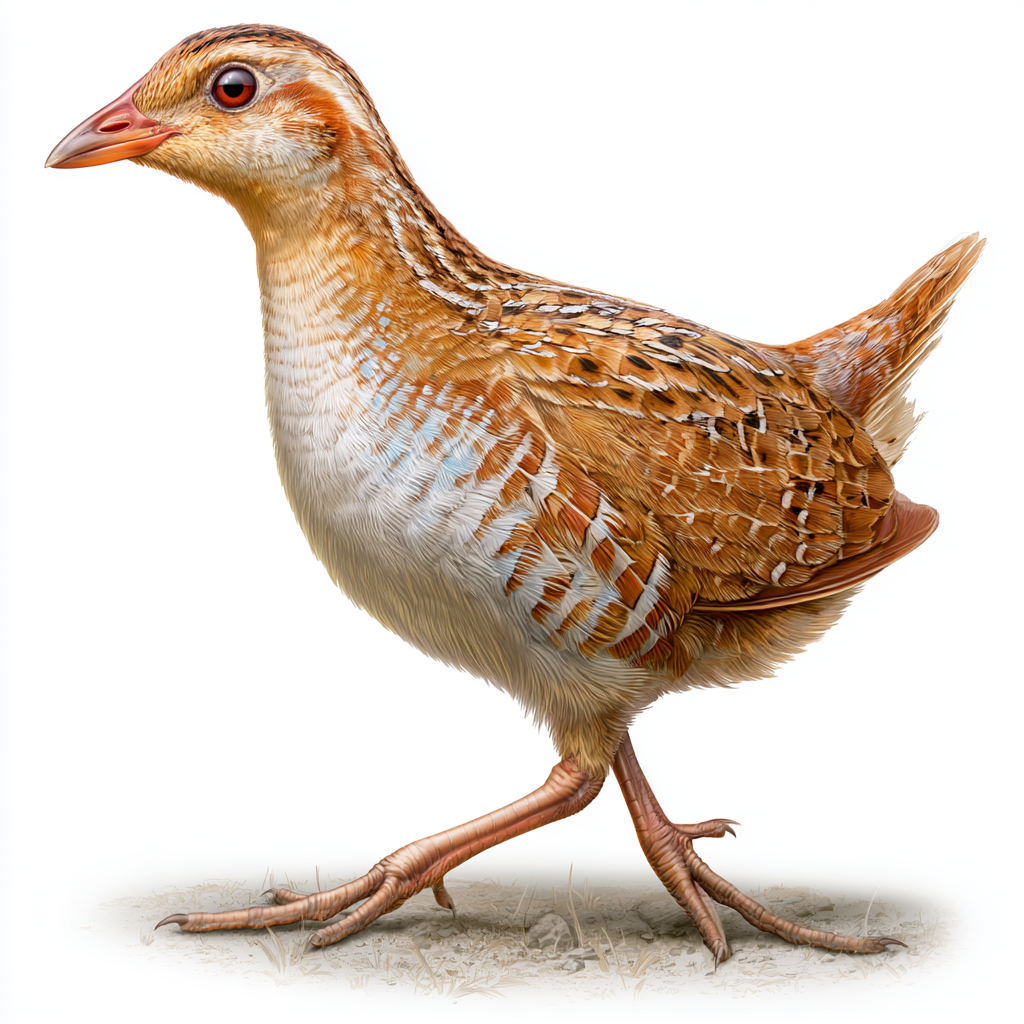
The Corncrake can be identified by its buff- or grey-streaked brownish-black upperparts, chestnut markings on the wings, and blue-grey underparts with rust-coloured and white bars on the flanks and undertail. Its strong, flesh-toned bill and pale grey legs are also distinctive features.
The Corncrake is slightly larger than a Moorhen, but smaller than a Grey Heron, with a length of around 27-30 cm.
The male Corncrake has a distinctive plumage featuring buff- or grey-streaked brownish-black upperparts, chestnut markings on the wings, and blue-grey underparts with rust-coloured and white bars on the flanks and undertail, with no significant seasonal variation.
The female Corncrake is similar to the male in plumage, with no notable differences.
The Corncrake's call is a loud, repetitive "krek krek" sound, often heard at night or early morning, which is used for territorial advertising and contact.
The Corncrake is a ground-dwelling bird that feeds on insects, seeds, and fruits, often running or walking through dense vegetation with its strong legs, and has a distinctive, low-flighting style when disturbed.
The Corncrake can be confused with the African Crake, but can be distinguished by its paler plumage, more streaked upperparts, and less plain face, as well as its larger size and different call.
Quick Facts
Who's spotted this?
Loading...
Recent community sightings
Loading recent sightings...