Sand Martin
Riparia riparia
The Sand Martin is a common summer visitor to Britain, typically seen from April to October, and can be found near sandy banks and cliffs where it breeds in colonies. It is widely distributed across the country, although its numbers have been declining in recent years.
Field Identification Guide
Use these features to identify Sand Martin in the field.
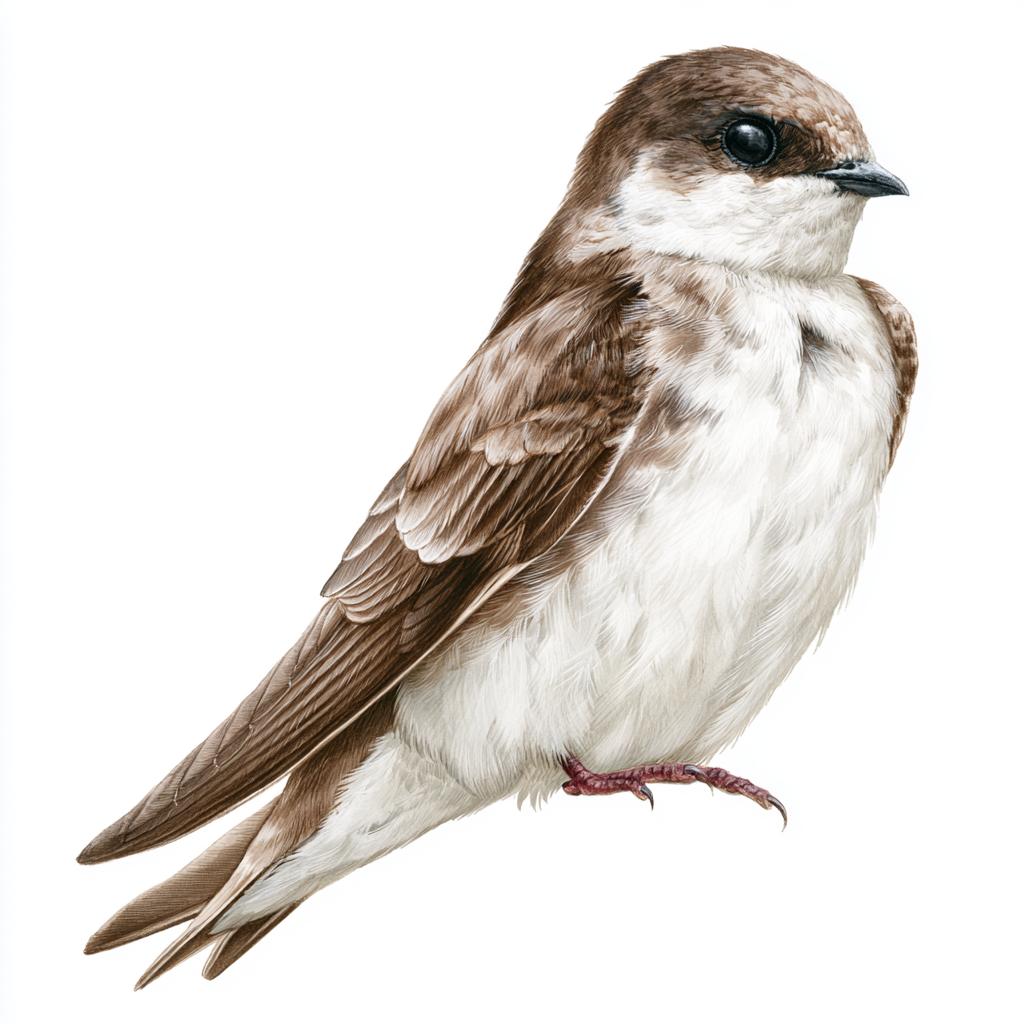
The Sand Martin can be identified by its brownish-grey upperparts, white underside, and distinctive white collar marking on its neck, as well as its forked tail and slender wings. Its dark brown crown and white forehead patch are also notable features.
The Sand Martin is smaller than a Starling, measuring around 10-12 cm in length, and is one of the smallest birds in the swallow family.
The male Sand Martin has a brownish-grey back, wings, and tail, with a white throat, breast, and belly, and a distinctive white collar marking on its neck, with a dark brown crown and white forehead patch.
The female Sand Martin is similar to the male, with the same brownish-grey upperparts and white underside, although her colours may be slightly duller and less vibrant.
The Sand Martin's call is a high-pitched, chirping "chip-chip-chip" or "tsee-tsee-tsee", often heard in flight or when the bird is perched near its nest.
Sand Martins are social birds that feed in flocks, catching insects in mid-air with their long, pointed wings and agile flight, and can often be seen flying low over water or sandy areas in search of food.
The Sand Martin can be confused with other swallow species, such as the House Martin or the Swallow, but can be distinguished by its brownish-grey upperparts, white collar marking, and forked tail, as well as its smaller size and more slender wings.
Quick Facts
Who's spotted this?
Loading...
Recent community sightings
Loading recent sightings...