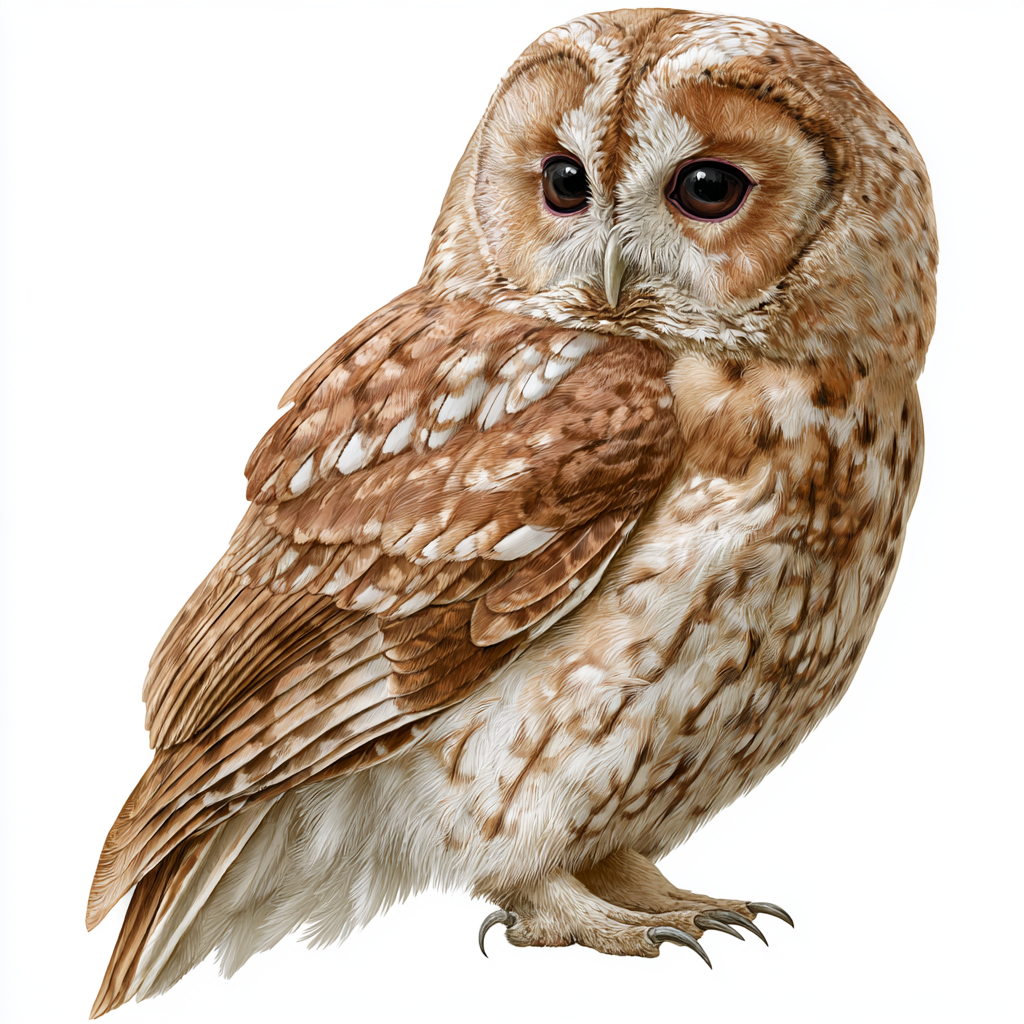
Tawny Owl
Strix aluco
The Tawny Owl is a medium-sized, nocturnal bird of prey that can be found in woodlands throughout Britain, particularly in areas with mature trees and abundant prey, with peak activity at dawn and dusk. It is a year-round resident in Britain, with a widespread distribution across the country.
Field Identification Guide
Use these features to identify Tawny Owl in the field.
The Tawny Owl can be identified by its rounded head, forward-facing ear tufts, and distinctive pale underparts with dark streaks, as well as its brown or grey upperparts. Its facial disc is also a key feature, with a dark rim and a pale centre.
The Tawny Owl is slightly larger than a Woodpigeon, but smaller than a Buzzard, with a stocky build and broad wings.
The male Tawny Owl has a brown or grey upperbody, with a pale underside featuring dark streaks, and its plumage remains relatively consistent throughout the year, with no significant seasonal variation.
The female Tawny Owl is similar to the male in terms of plumage, with the same brown or grey upperparts and pale underparts with dark streaks.
The Tawny Owl's call is a distinctive, low-pitched "hoo-h'ooh" or "ke-wick", often described as a haunting, whistled sound that can be heard at night, particularly during the breeding season.
The Tawny Owl is a nocturnal hunter, feeding on small mammals, birds, and insects, with a silent, wingbeat-free flight that allows it to ambush its prey, and it is also known for its highly territorial behaviour, with pairs defending their territory against other Tawny Owls.
The Tawny Owl can be confused with the Barn Owl, but can be distinguished by its more rounded head, darker upperparts, and lack of a heart-shaped facial disc, as well as its distinctive call and more woodland-based habitat.
Quick Facts
Who's spotted this?
Loading...
Recent community sightings
Loading recent sightings...