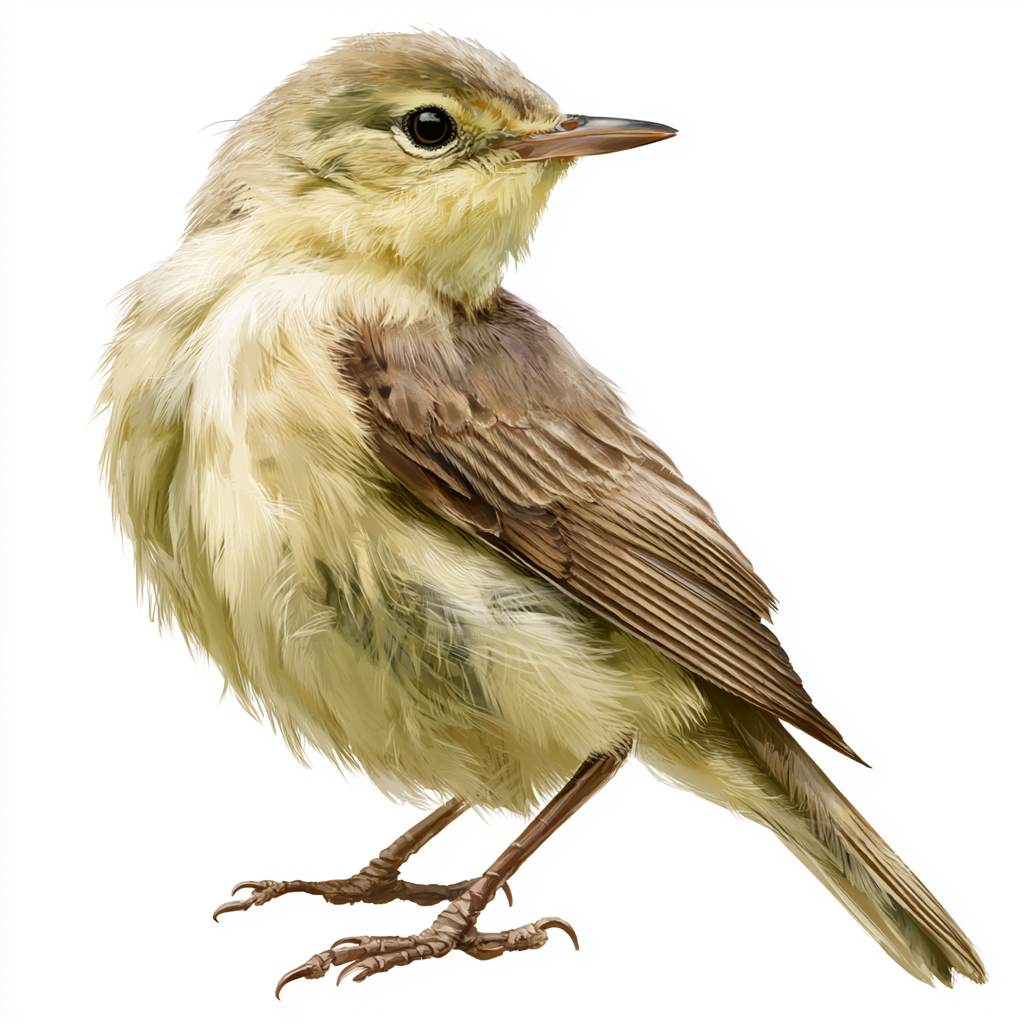
Melodious Warbler
Hippolais polyglotta
The Melodious Warbler is a rare migrant to Britain, typically seen in the southern regions during the spring and autumn, often in areas with open woodland and bushes. It is more commonly found in its breeding grounds in southwest Europe and northwest Africa, but occasional sightings can be made in Britain, particularly on the southern coast.
Field Identification Guide
Use these features to identify Melodious Warbler in the field.
At a glance, the Melodious Warbler can be identified by its plain greenish-yellow plumage, white underside, and distinctive white eye-ring, as well as its relatively long and broad tail. Its lack of distinctive markings or wing bars also helps to distinguish it from other warbler species.
The Melodious Warbler is slightly larger than a Blue Tit, but smaller than a Starling, making it a medium-sized passerine bird.
The male Melodious Warbler has a bright greenish-yellow plumage on its back and wings, with a white underside and a distinctive white eye-ring, with little to no seasonal variation in its plumage.
The female Melodious Warbler is similar to the male, with the same greenish-yellow plumage and white underside, making it difficult to distinguish between the sexes based on plumage alone.
The Melodious Warbler's call is a sharp, metallic "tek" or "tink" sound, while its song is a melodic and repetitive phrase, often described as a series of whistled notes.
The Melodious Warbler is an active and agile bird, often seen flitting between bushes and trees in search of insects and spiders, and can be recognized by its rapid and direct flight style.
The Melodious Warbler can be confused with the Icterine Warbler, but can be distinguished by its lack of wing bars and white eye-ring, as well as its more subdued and greenish-yellow plumage, whereas the Icterine Warbler has a more vibrant yellow plumage and distinctive wing bars.
Quick Facts
Who's spotted this?
Loading...
Recent community sightings
Loading recent sightings...