Black-throated Diver
Gavia arctica
The Black-throated Diver is a rare but occasional visitor to Britain, typically seen during migration periods or as a wintering bird in coastal areas, particularly in the north and west. It can be spotted in Britain from October to April, with the majority of sightings occurring in Scotland and northern England.
Field Identification Guide
Use these features to identify Black-throated Diver in the field.
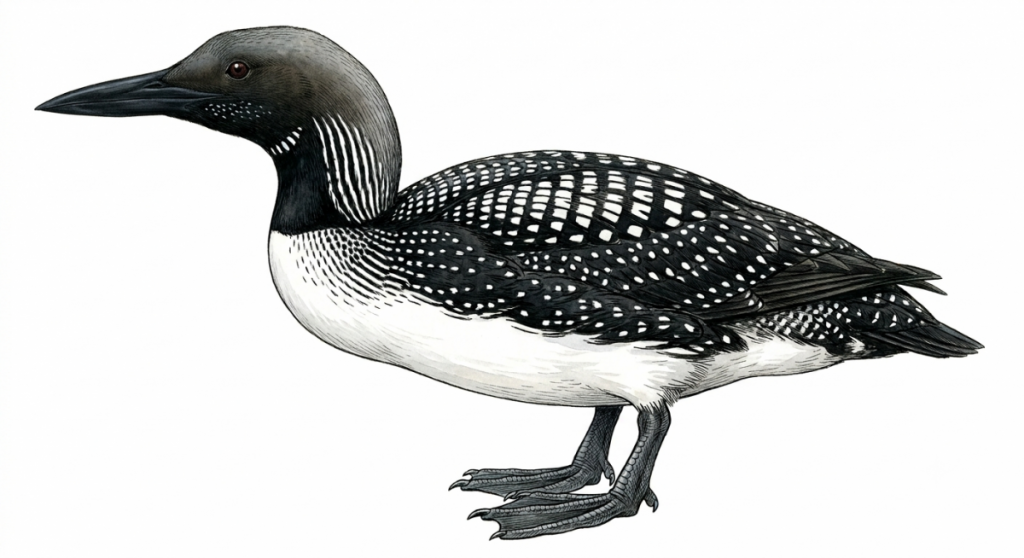
The Black-throated Diver can be identified by its distinctive black throat patch, grey back, and white belly, as well as its slender neck and pointed bill. Its dark grey to black head and neck, with a sharp border between the black throat patch and white belly, are also key distinguishing features.
The Black-throated Diver is larger than a Grey Heron, but smaller than a Mute Swan, with a length of approximately 53-69 cm.
The male Black-throated Diver has a breeding plumage characterized by a black throat patch, grey back, and white belly, with a black and white checkerboard pattern on its back, while in winter, it has a more subdued grey and white plumage.
The female Black-throated Diver is similar to the male, with no significant differences in plumage, although females may have a slightly less intense black throat patch.
The Black-throated Diver's call is a low, haunting wail, often described as a mournful or yodelling sound, typically heard during the breeding season or at night.
The Black-throated Diver is a skilled diver, feeding on fish, crustaceans, and other aquatic prey in coastal waters, and is known for its swift and agile flight, as well as its tendency to swim low in the water with its body submerged.
The Black-throated Diver can be confused with the Red-throated Diver, but can be distinguished by its black throat patch, grey back, and larger size, as well as its more subdued winter plumage, whereas the Red-throated Diver has a reddish throat patch and a more slender neck.
Quick Facts
Who's spotted this?
Loading...
Recent community sightings
Loading recent sightings...