Pallid Harrier
Circus macrourus
The Pallid Harrier is a rare but increasing vagrant to Great Britain, typically seen during migration periods, with sightings mostly limited to the eastern and southern regions. It is more commonly associated with its breeding grounds in southern eastern Europe and central Asia, and wintering grounds in India and southeast Asia.
Field Identification Guide
Use these features to identify Pallid Harrier in the field.
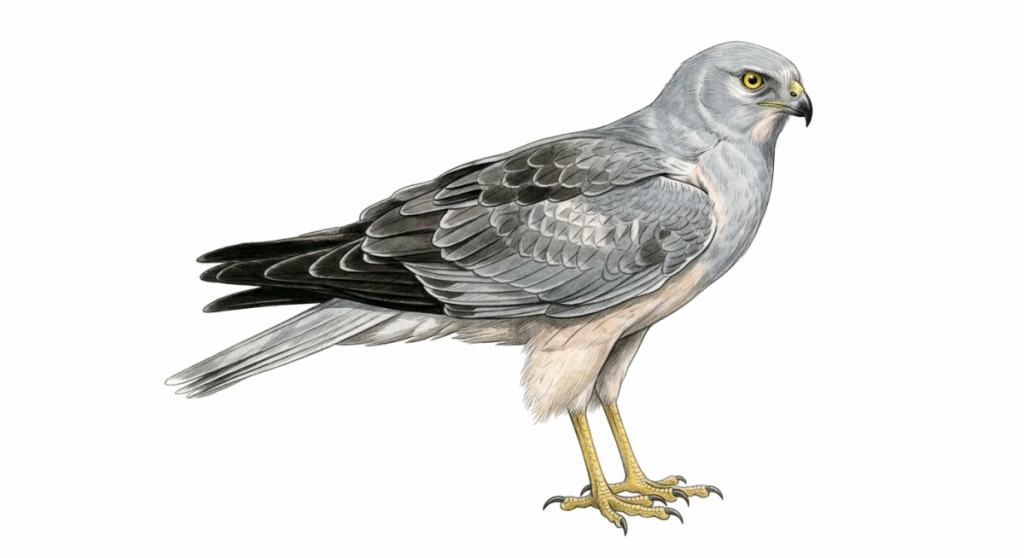
The Pallid Harrier can be identified by its pale underside, white rump patch, and long, narrow wings, which distinguish it from other harrier species. Its pale head and breast, with a distinctive dark stripe through the eye, are also notable features.
The Pallid Harrier is slightly larger than a Moorhen, with a more slender build, making it a medium-sized bird of prey.
The male Pallid Harrier has a grey back and wings, with a pale head, breast, and belly, and a distinctive white rump patch, with some individuals showing a bluish-grey cast to the upperparts.
The female Pallid Harrier is similar to the male but has a brownish-grey back and wings, with a pale head, breast, and belly, and a white rump patch, making it slightly more subdued in colour than the male.
The Pallid Harrier's call is a sharp, high-pitched "kek-kek-kek" or "kyek-kyek-kyek", often repeated in a series, and is typically heard during the breeding season or when the bird is alarmed.
The Pallid Harrier is a low-flying, agile hunter, typically quartering open fields and grasslands in search of small mammals, birds, and insects, with a distinctive hovering flight style when spotting prey.
The Pallid Harrier can be confused with the Montagu's Harrier, but can be distinguished by its pale underside, white rump patch, and narrower wings, as well as its more slender build and longer tail.
Quick Facts
Who's spotted this?
Loading...
Recent community sightings
Loading recent sightings...