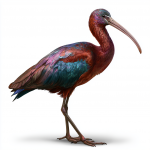
Blackpoll Warbler
Setophaga striata
The Blackpoll Warbler is a rare vagrant to western Europe, including Britain, where it can be seen during migration periods, typically in the autumn. It is most likely to be spotted on the eastern coast of Britain, particularly on days with easterly winds.
Field Identification Guide
Use these features to identify Blackpoll Warbler in the field.
The Blackpoll Warbler can be identified by its distinctive black cap, white cheeks, and white wing bars, which distinguish it from other warbler species. Its black and white plumage is also a key feature, with a prominent cap and white undersides.
The Blackpoll Warbler is smaller than a Starling, measuring around 10-12 cm in length, which is comparable to a Goldcrest or a Firecrest.
The male Blackpoll Warbler has a striking black cap, white cheeks, and white wing bars, with a black back and white undersides, although in autumn, the black plumage can be more brownish.
The female Blackpoll Warbler is similar to the male but has a greyish-brown cap instead of black, and less distinctive white wing bars, with a more subdued colouration overall.
The Blackpoll Warbler's call is a sharp, metallic "zip" or "tzit" sound, while its song is a series of musical phrases that sound like "weet-weet-weet-weet".
The Blackpoll Warbler is an active and agile bird, feeding on insects and spiders in trees and shrubs, with a distinctive flight style that involves rapid wingbeats and short glides.
The Blackpoll Warbler can be confused with the Yellow Warbler or the Arctic Warbler, but can be distinguished by its black cap, white cheeks, and white wing bars, as well as its smaller size and more agile flight.
Quick Facts
Who's spotted this?
Loading...
Recent community sightings
Loading recent sightings...