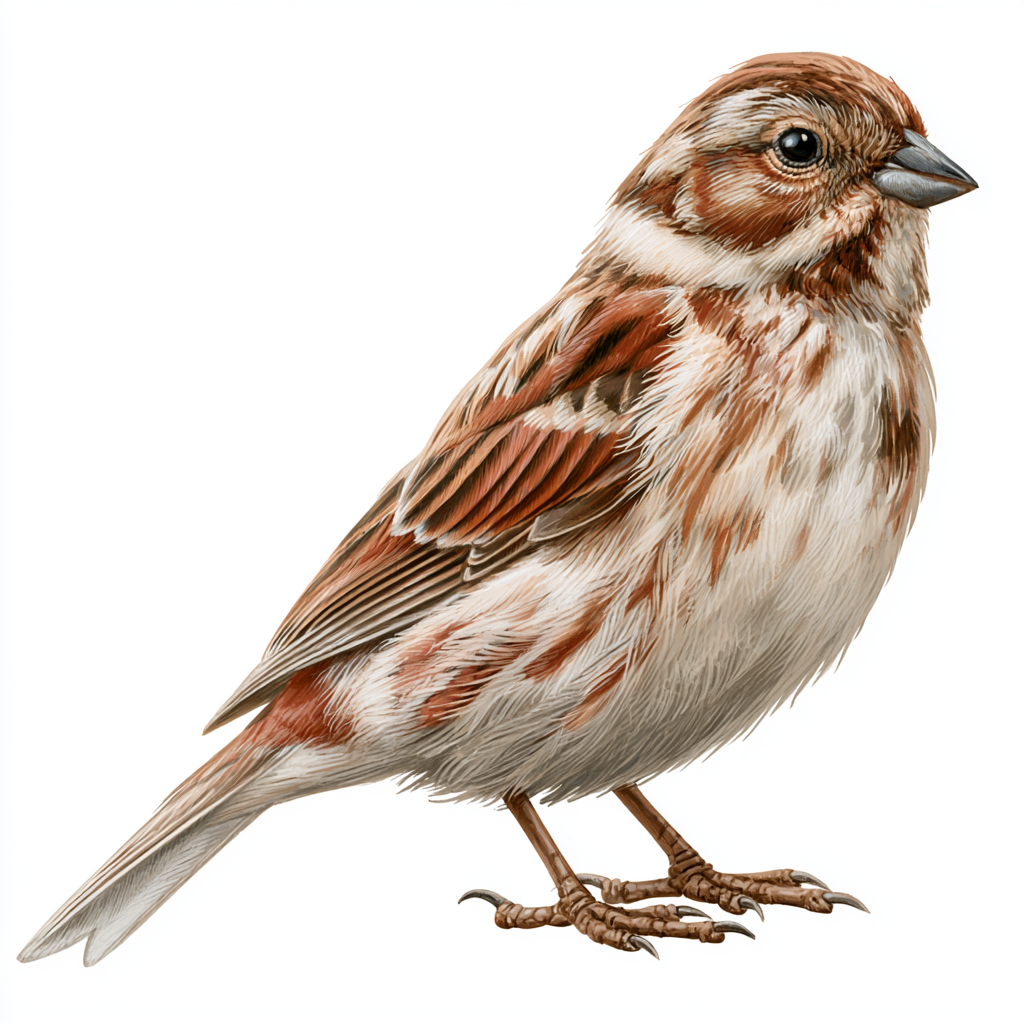
Pine Bunting
Emberiza leucocephalos
The Pine Bunting is a rare winter visitor to Britain, typically seen in the eastern and southern regions, particularly during periods of harsh weather on the continent. It is most likely to be spotted in areas with coniferous trees, such as pine plantations, from October to April.
Field Identification Guide
Use these features to identify Pine Bunting in the field.
The Pine Bunting can be identified by its distinctive white crown patches, brownish-grey back, and white outer tail feathers, which are visible in flight. Its head pattern, with a white throat patch and dark stripes, is also a key feature.
The Pine Bunting is slightly smaller than a Starling, with a more compact build.
The male Pine Bunting has a greyish-brown back, white crown patches, and a white throat patch, with a black stripe above the eye and a dark brown stripe below, its plumage remains relatively consistent throughout the year.
Similar to the male, but with a more subdued colouration, the female Pine Bunting has a brownish-grey back and less distinct head markings.
The Pine Bunting's call is a sharp, metallic "tek" or "tink" sound, while its song is a series of short, melodic phrases.
Pine Buntings are ground-foraging birds, feeding on seeds, grains, and insects, and are often seen walking or running on the ground in search of food, they also have a distinctive flight style, with a series of rapid wingbeats followed by a brief glide.
The Pine Bunting can be confused with the Reed Bunting, but can be distinguished by its white crown patches, greyish-brown back, and white outer tail feathers, which are not found in the Reed Bunting.
Quick Facts
Who's spotted this?
Loading...
Recent community sightings
Loading recent sightings...


