Glossy Ibis
Plegadis falcinellus
The Glossy Ibis is a rare but occasional visitor to Britain, typically seen in wetland areas during the summer months, with sightings often associated with coastal marshes and estuaries. It is a distinctive and attractive species, with a notable presence in southern Europe, but only sporadic appearances in the UK.
Field Identification Guide
Use these features to identify Glossy Ibis in the field.
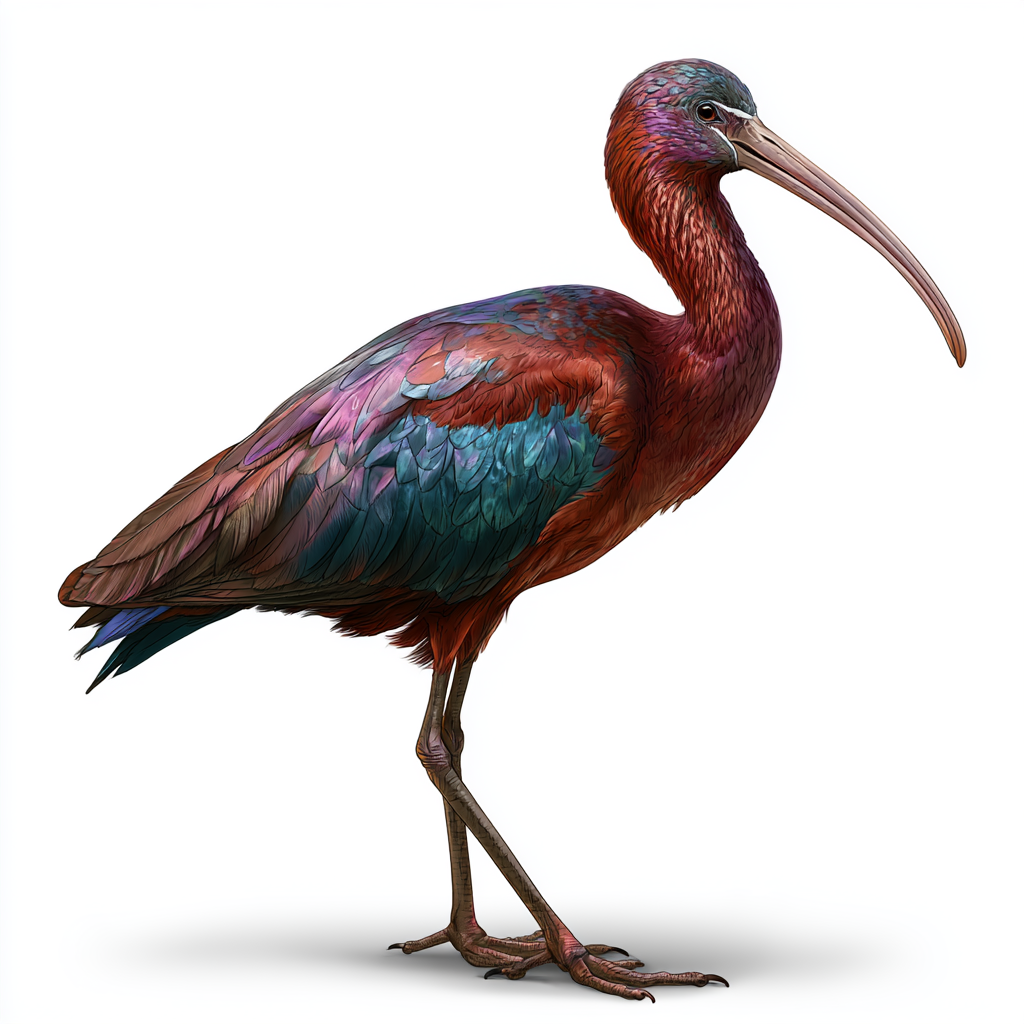
The Glossy Ibis can be identified at a glance by its sleek, dark plumage, curved bill, and long, slender legs, with a distinctive purple sheen to its feathers in the right light. Its wings and tail are broad and rounded, and it has a distinctive white stripe on its forehead.
The Glossy Ibis is slightly larger than a Lapwing, with a length of around 50-60 cm, making it a medium-sized waterbird.
The male Glossy Ibis has a glossy, dark brown plumage with a purple sheen, and a metallic green and bronze tint to its wings and tail, with little seasonal variation in its appearance.
The female Glossy Ibis is similar to the male, with the same glossy, dark brown plumage and purple sheen, although it may be slightly duller in colour.
The Glossy Ibis has a harsh, grunting call, often transcribed as a loud "hronk" or "krank", which is typically heard when the bird is in flight or alarmed.
The Glossy Ibis is a social bird that feeds on a variety of aquatic animals, including insects, crustaceans, and small fish, using its curved bill to probe into mud and shallow water, and is known for its slow, deliberate flight style.
The Glossy Ibis can be confused with the Spoonbill, but can be distinguished by its curved bill and darker plumage, as well as its more slender legs and neck, and the presence of a white stripe on its forehead.
Quick Facts
Who's spotted this?
Loading...
Recent community sightings
Loading recent sightings...