Lapland Bunting
Calcarius lapponicus
The Lapland Bunting is a rare but exciting visitor to Britain, typically seen during the autumn and winter months, particularly in the northern and eastern regions. It is a migratory species that breeds in the Arctic tundra, making its appearances in Britain a notable event for birdwatchers.
Field Identification Guide
Use these features to identify Lapland Bunting in the field.
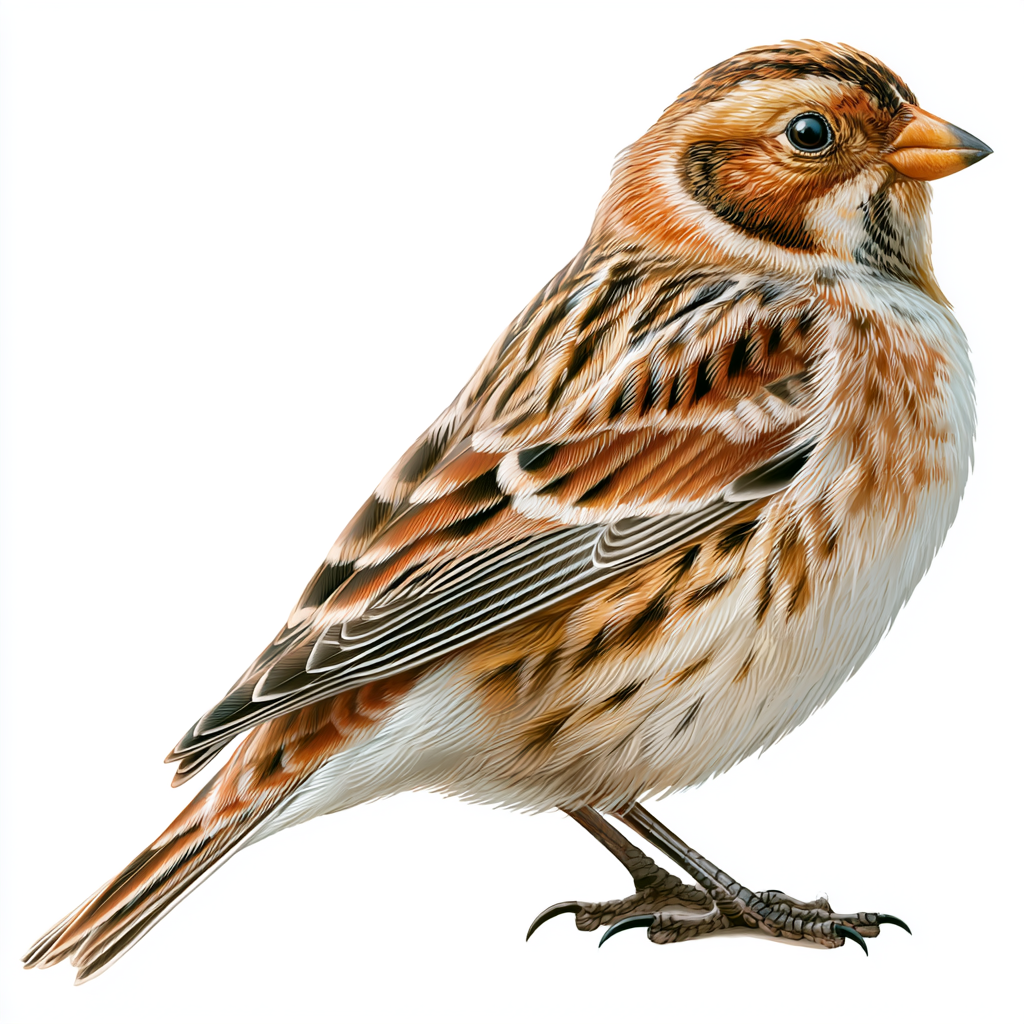
The Lapland Bunting can be identified by its distinctive black throat patch, chestnut nape, and white outer tail feathers, which are visible in flight. Its streaked back and wings also help to distinguish it from other bunting species.
The Lapland Bunting is slightly smaller than a Skylark, with a more compact build.
The male Lapland Bunting has a distinctive breeding plumage, characterized by a black throat patch, chestnut nape, and greyish-brown back and wings, with a white belly and white outer tail feathers. In winter, the male's plumage becomes more subdued, with the black throat patch being less pronounced.
The female Lapland Bunting is similar to the male, but lacks the distinctive black throat patch and has a more subdued colouration overall, with a streaked back and wings and a pale belly.
The Lapland Bunting's call is a sharp, metallic "tik" or "tink" sound, often repeated in a series, while its song is a melodious, warbling phrase that is typically heard during the breeding season.
Lapland Buntings are ground-dwelling birds that feed on seeds, insects, and other small invertebrates, often in areas with low vegetation and bare ground. They have a distinctive flight style, with a series of rapid wingbeats followed by a brief glide.
The Lapland Bunting can be confused with other bunting species, such as the Snow Bunting, but can be distinguished by its distinctive black throat patch, streaked back and wings, and white outer tail feathers.
Quick Facts
Who's spotted this?
Loading...
Recent community sightings
Loading recent sightings...