Tibetan Sand Plover
Anarhynchus atrifrons
The Tibetan Sand Plover is a rare and occasional visitor to Britain, typically seen during migration periods, with most sightings occurring in the eastern and southern regions. It is most likely to be spotted in Britain during the spring and autumn, although such occurrences are extremely rare.
Field Identification Guide
Use these features to identify Tibetan Sand Plover in the field.
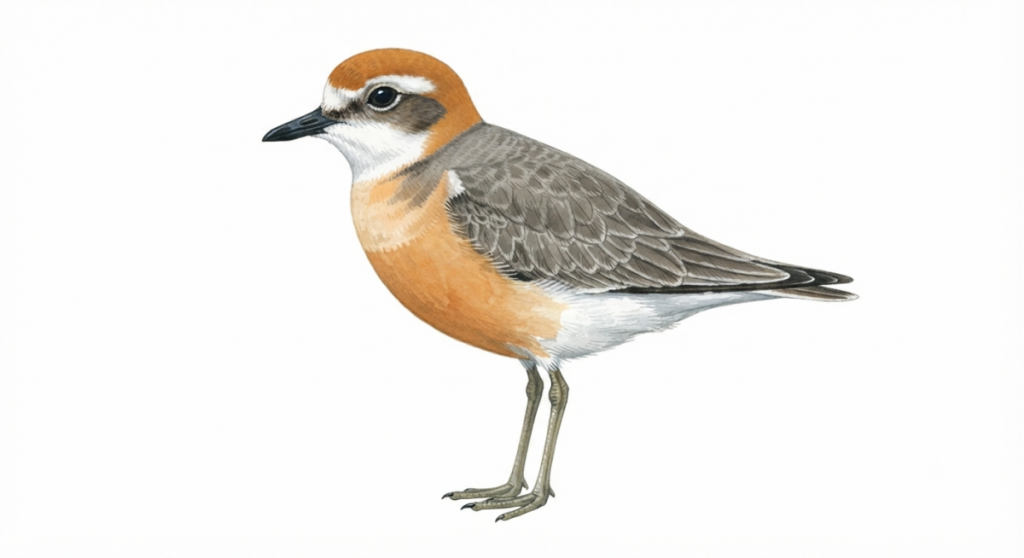
The Tibetan Sand Plover can be identified by its brownish-grey plumage, white belly, and distinctive black stripe across its forehead, as well as its relatively long legs and straight black bill. Its dark brown mantle and scapulars also help distinguish it from other similar species.
The Tibetan Sand Plover is slightly smaller than a Lapwing, with a more compact body and longer legs.
The male Tibetan Sand Plover has a breeding plumage characterized by a black forehead stripe, brownish-grey upperparts, and a white belly, with some individuals showing a partial black breast band during the breeding season.
The female Tibetan Sand Plover is similar to the male but often lacks the complete black forehead stripe and breast band, or has a less pronounced version of these markings.
The Tibetan Sand Plover's call is a sharp, high-pitched "tik" or "tink" sound, often repeated in a series of three or four notes.
The Tibetan Sand Plover is a ground-foraging bird that feeds on small invertebrates, seeds, and fruits, often running or standing still to scan for prey, and when alarmed, it will take to the skies with a swift, direct flight.
The Tibetan Sand Plover can be confused with the Kentish Plover or the Little Ringed Plover, but it can be distinguished from these species by its larger size, longer legs, and distinctive black forehead stripe, as well as its more subdued breeding plumage.
Quick Facts
Who's spotted this?
Loading...
Recent community sightings
Loading recent sightings...