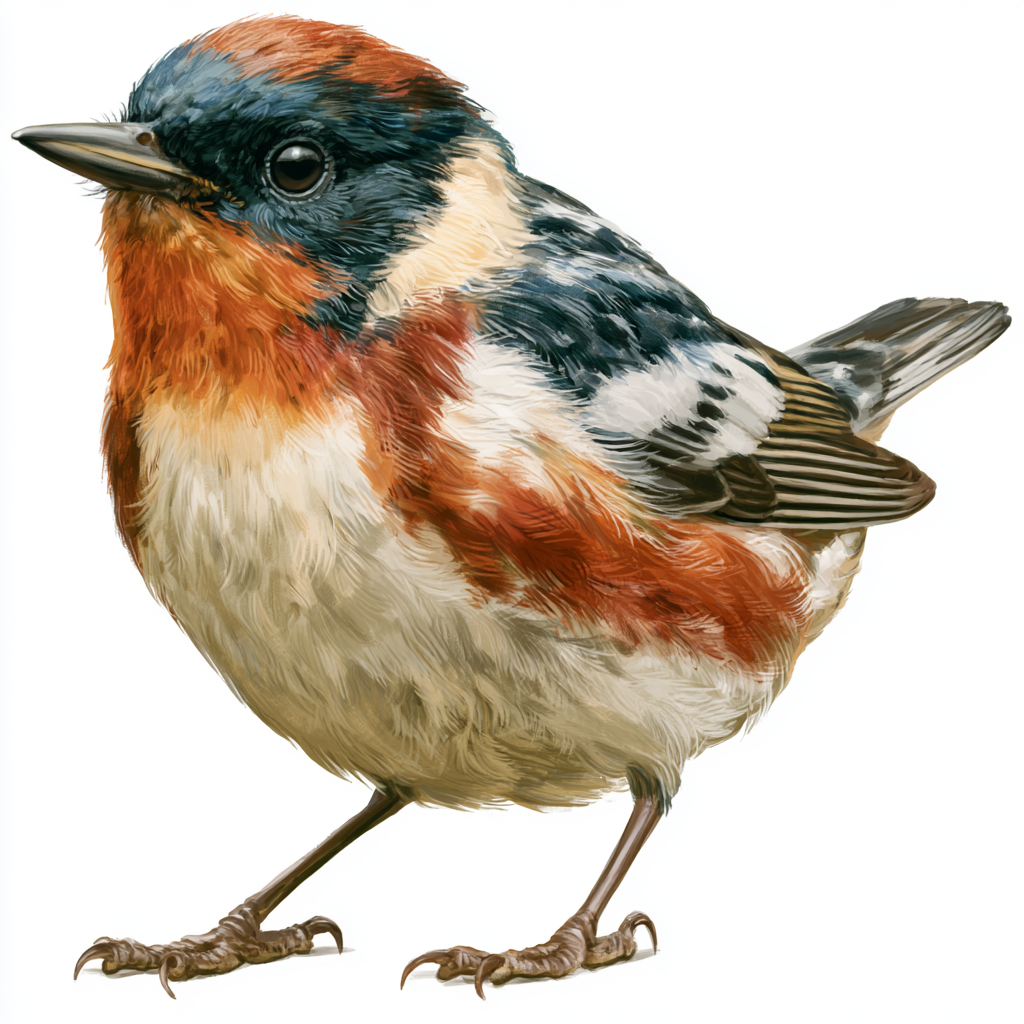
Bay-breasted Warbler
Setophaga castanea
The Bay-breasted Warbler is a rare migrant to Britain, typically seen during the autumn, with most sightings occurring on the eastern and southern coasts. It is a small, energetic bird that can be spotted in woodland edges and scrubby areas, often flitting between trees in search of insects.
Field Identification Guide
Use these features to identify Bay-breasted Warbler in the field.
The Bay-breasted Warbler can be identified by its distinctive bay-coloured breast, white wing bars, and a greyish-brown back with a subtle greenish tint. Its facial markings, including a pale yellow throat and a dark crown, also help to distinguish it from other warblers.
The Bay-breasted Warbler is smaller than a Starling, measuring around 11-12 cm in length, and is comparable in size to a Goldcrest or a Firecrest.
The male Bay-breasted Warbler has a distinctive bay-coloured breast, a greyish-brown back, and white wing bars, with a dark crown and a pale yellow throat, while in autumn, the breast colour may be more subdued, becoming a pale brownish-grey.
The female Bay-breasted Warbler is similar to the male, but with a paler, more subdued breast colour, and a generally more subdued overall plumage, making it slightly less conspicuous than the male.
The Bay-breasted Warbler's call is a sharp, high-pitched "chip" or "tzip" sound, often repeated in a series, while its song is a series of short, musical phrases, often described as a rapid, tinkling melody.
The Bay-breasted Warbler is an active, agile bird that forages for insects and spiders in trees and shrubs, often flying between branches with a rapid, darting motion, and can be seen hovering in front of leaves to catch prey.
The Bay-breasted Warbler can be confused with the Blackpoll Warbler, but can be distinguished by its bay-coloured breast, which is darker and more reddish-brown in the Blackpoll, and by its white wing bars, which are narrower and more yellowish in the Blackpoll.
Quick Facts
Who's spotted this?
Loading...
Recent community sightings
Loading recent sightings...


