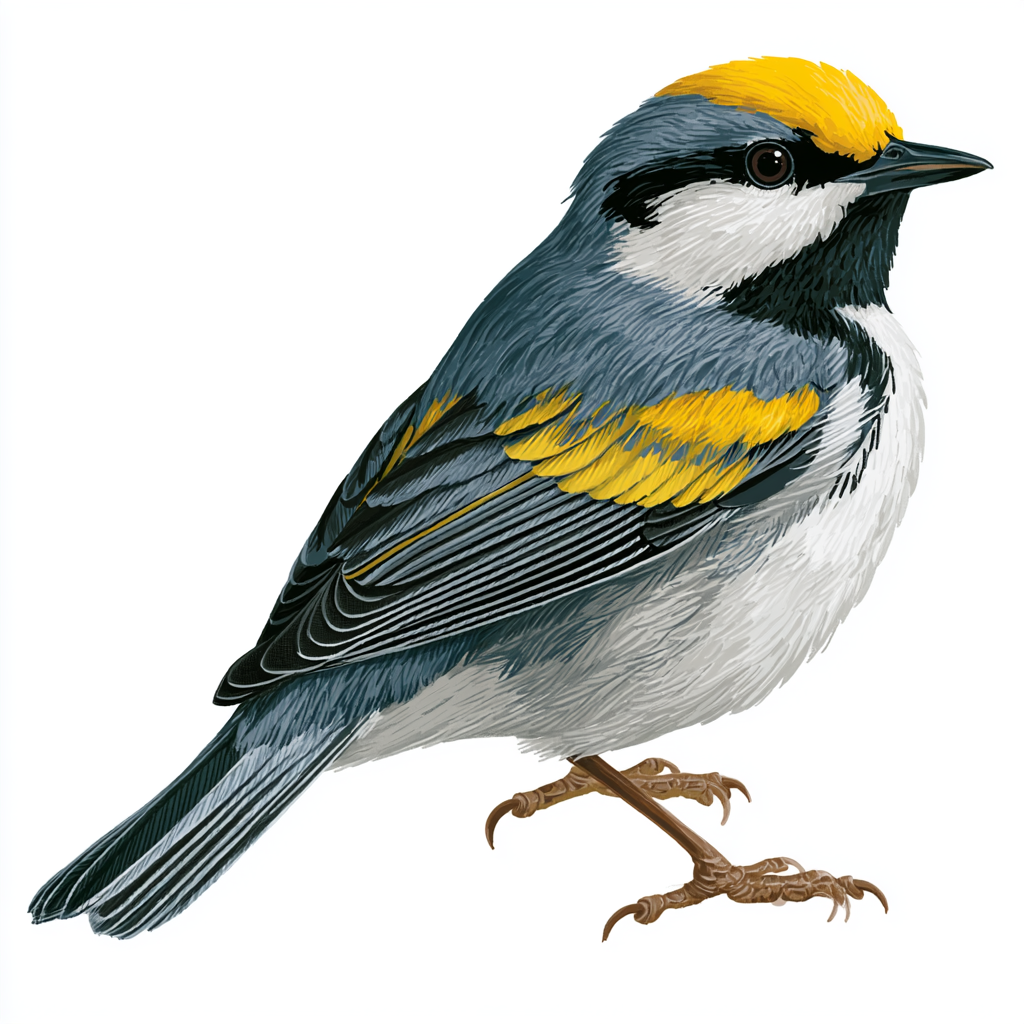
Golden-winged Warbler
Vermivora chrysoptera
The Golden-winged Warbler is a rare migrant to Britain, typically seen during spring and autumn, with most sightings occurring in the southern and eastern regions of the country. It is a highly sought-after species among British birders, due to its infrequent visits to the UK.
Field Identification Guide
Use these features to identify Golden-winged Warbler in the field.
The Golden-winged Warbler can be identified by its bright yellow wing bars, white eye rings, and greyish-brown back, which distinguish it from other warbler species. Its yellow crown and black throat patch are also distinctive features.
The Golden-winged Warbler is smaller than a Starling, measuring around 10-12 cm in length, and is similar in size to a Willow Warbler.
The male Golden-winged Warbler has a greyish-brown back, white belly, and yellow wing bars, with a yellow crown and a black throat patch, which is most prominent during the breeding season.
The female Golden-winged Warbler is similar to the male, but with a less pronounced black throat patch and a more subdued yellow crown.
The Golden-winged Warbler's call is a sharp, high-pitched "zee" or "zee-zee-zee", while its song is a series of short, musical phrases, often described as "zee-zee-zee-zee-zee".
The Golden-winged Warbler is an insectivorous species, feeding on small insects and spiders, and can be seen flitting between trees and shrubs in search of food, with a rapid, agile flight style.
The Golden-winged Warbler can be confused with the Blue-winged Warbler, but can be distinguished by its yellow wing bars and greyish-brown back, as well as its different call and song, with the Blue-winged Warbler having a more yellowish back and a distinctive "bee-bzz" call.
Quick Facts
Who's spotted this?
Loading...
Recent community sightings
Loading recent sightings...


