Blue-winged Teal
Spatula discors
The Blue-winged Teal is a rare migrant to Britain, typically seen during the autumn and winter months, with most sightings occurring in the southern and western regions. It is an occasional visitor to the UK, with only a handful of records each year, often in association with other wildfowl.
Field Identification Guide
Use these features to identify Blue-winged Teal in the field.
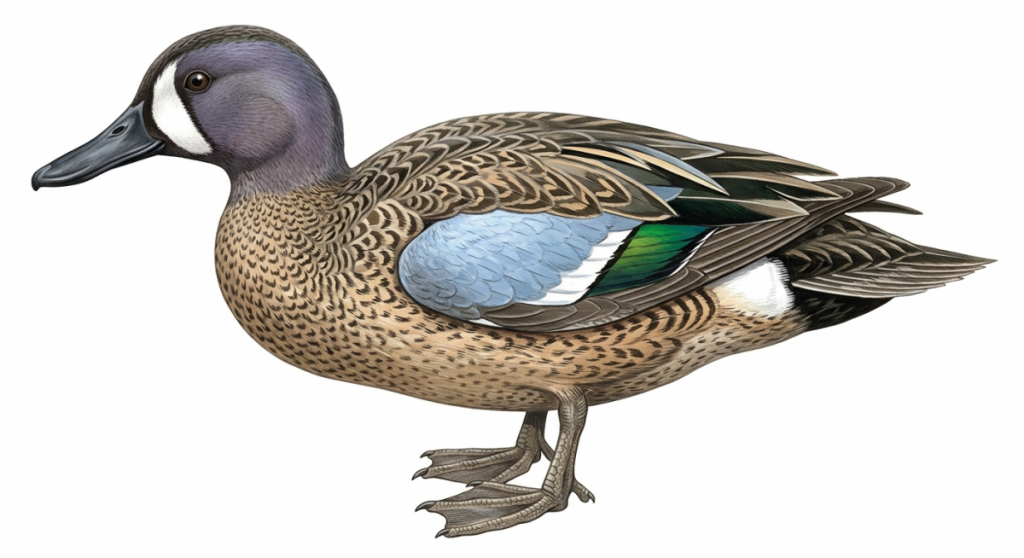
The Blue-winged Teal can be identified by its distinctive blue-grey wing patch, pale belly, and dark grey breast patch, as well as its relatively small size and short legs. Its head shape and bill size are also notable features, with a broad, rounded head and a short, black bill.
The Blue-winged Teal is smaller than a Mallard, but larger than a Garganey, with a length of approximately 35-40 cm.
The male Blue-winged Teal has a grey-brown back, pale grey wings with a distinctive blue-grey patch, and a dark grey breast patch, with a pale yellowish-brown head and neck during the breeding season, which fades to a more subdued grey-brown in winter.
The female Blue-winged Teal is similar to the male, but with a more subdued colouration, lacking the bright blue-grey wing patch and having a more mottled brown back and wings.
The Blue-winged Teal has a high-pitched, whistling call, often transcribed as a sharp "peep" or "weep", which is typically given by both males and females.
The Blue-winged Teal is a dabbling duck, feeding on small aquatic plants, insects, and crustaceans in shallow water, and is often seen swimming or foraging in wetlands, with a rapid, direct flight style when disturbed.
The Blue-winged Teal can be confused with the Garganey, which has a similar size and shape, but can be distinguished by its distinctive blue-grey wing patch and pale belly, as well as its shorter legs and broader head.
Quick Facts
Who's spotted this?
Loading...
Recent community sightings
Loading recent sightings...