Taiga Flycatcher
Ficedula albicilla
The Taiga Flycatcher is a rare vagrant to western Europe, including Britain, where it may be spotted during migration periods, typically in the autumn. It is most likely to be seen in areas with suitable habitat, such as woodland edges or taiga-like forests, although such sightings are extremely uncommon.
Field Identification Guide
Use these features to identify Taiga Flycatcher in the field.
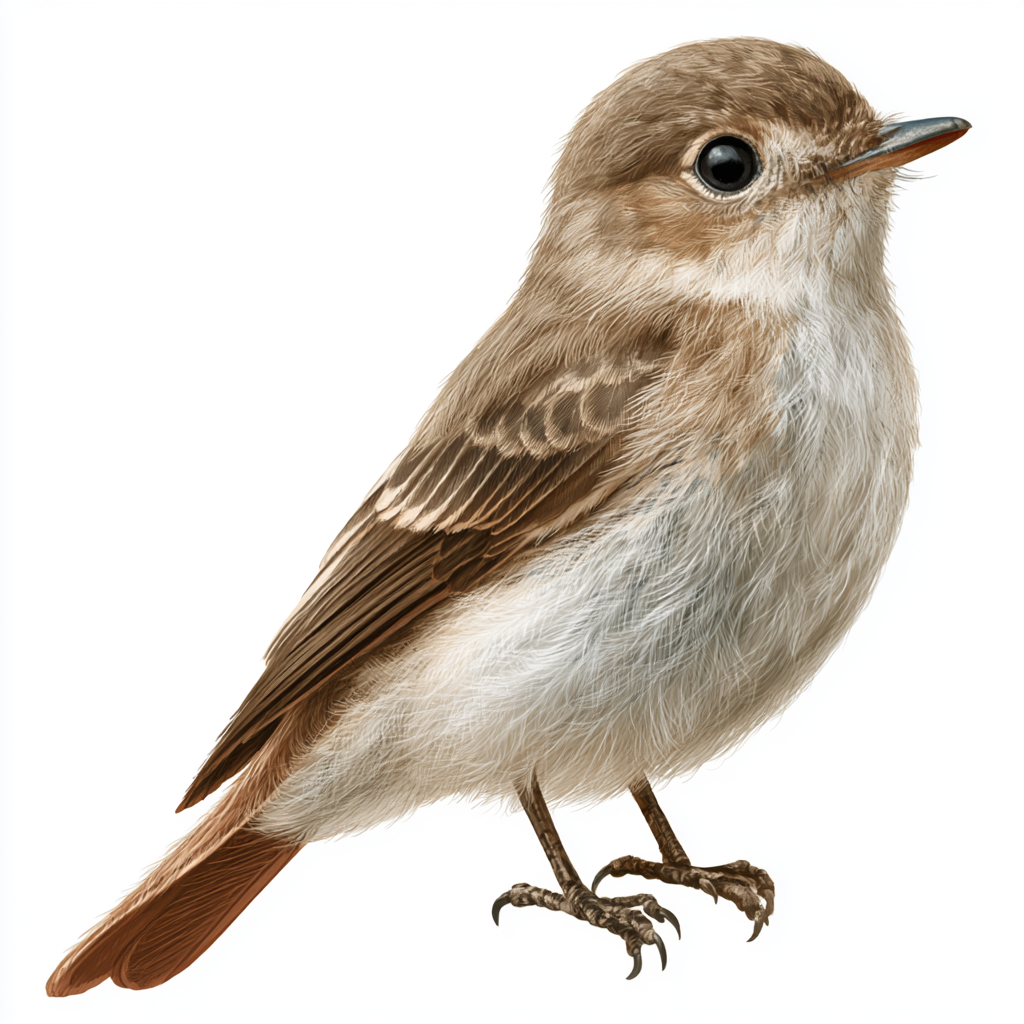
The Taiga Flycatcher can be identified by its distinctive orange-red throat patch in breeding males, blue-tinged grey ear coverts, and a blackish tail flanked by white. The combination of these features, along with its overall size and shape, helps to distinguish it from other flycatcher species.
The Taiga Flycatcher is smaller than a Starling, measuring around 12-13 cm in length, which is comparable to the size of a Robin or a Blue Tit.
The male Taiga Flycatcher has a distinctive orange-red colouration on its throat, with blue-tinged grey ear coverts and sides of the neck, while the rest of its upperparts are brown and the underparts are mostly white. The intensity of the orange-red throat patch may vary depending on the breeding season.
The female Taiga Flycatcher has brown upperparts, a blackish tail flanked by white, and buffish-brown breast, with mostly white underparts, lacking the distinctive orange-red throat patch of the male.
The Taiga Flycatcher's call is a sharp, high-pitched "tick" or "tsik" sound, often repeated in a series, while its song is a melodic, whistled phrase, typically heard during the breeding season.
The Taiga Flycatcher is an active, agile bird that feeds on insects, often catching them in mid-air, and can be seen making short, swift flights between perches. It is a migratory species, breeding in northern Eurasia and wintering in South and South-east Asia.
The Taiga Flycatcher can be confused with the Red-breasted Flycatcher, but can be distinguished by the extent of the red colouration on the throat and breast, as well as the colour of the tail, which is blackish in the Taiga Flycatcher and brown in the Red-breasted Flycatcher.
Quick Facts
Who's spotted this?
Loading...
Recent community sightings
Loading recent sightings...