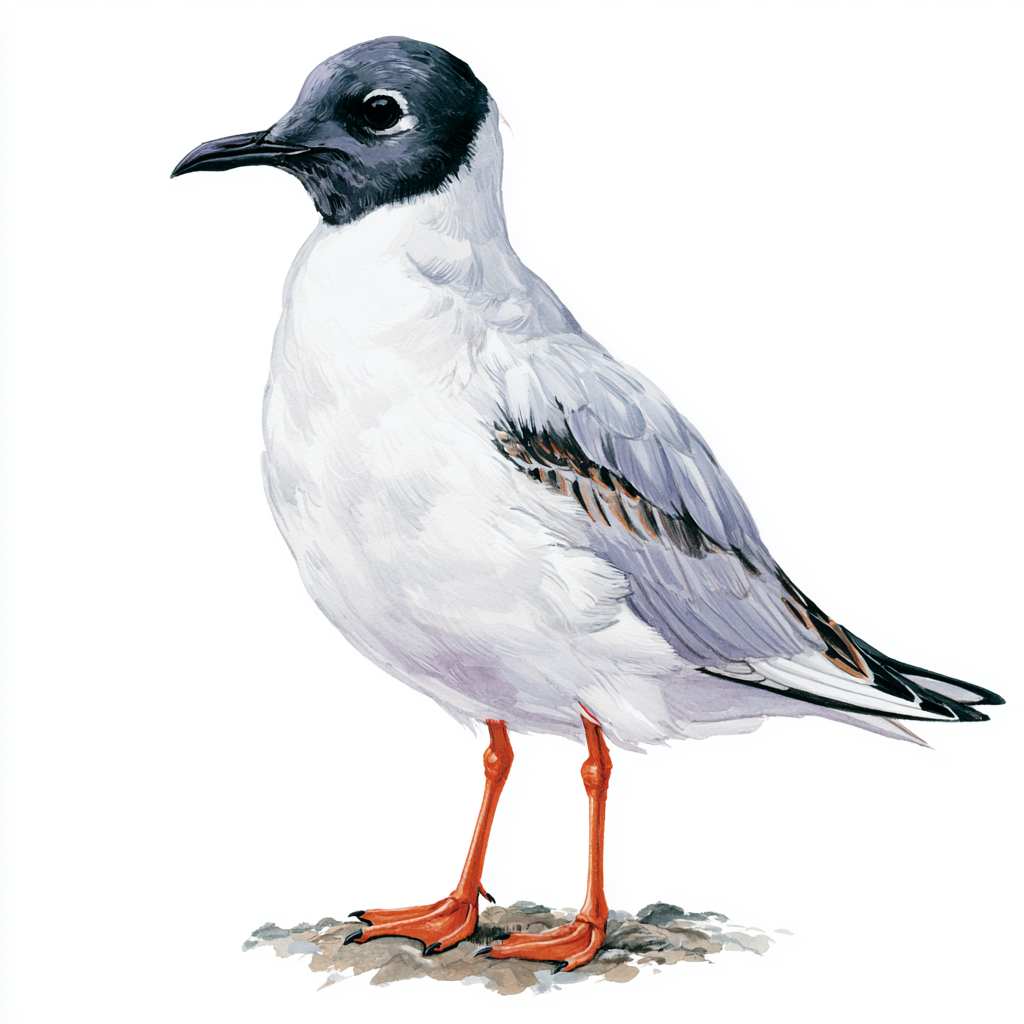
Bonaparte’s Gull
Chroicocephalus philadelphia
Bonaparte's Gull is a rare but annual vagrant to Britain, typically seen during the summer months, particularly in the northern and western regions, often in association with other gull species. It is most commonly recorded as a passage migrant, with individuals occasionally lingering at coastal locations or inland wetlands.
Field Identification Guide
Use these features to identify Bonaparte’s Gull in the field.
The Bonaparte's Gull can be identified by its small size, black hood, and white wing tips, as well as its distinctive black bill and legs. Its slender build and rounded head shape also help to distinguish it from other gull species.
The Bonaparte's Gull is smaller than a Black-headed Gull, being roughly the size of a Large Tern or slightly larger than a Woodpigeon.
The male Bonaparte's Gull has a breeding plumage characterized by a black hood, white underside, and grey back, with white wing tips and a black bill, while in winter it loses the black hood, retaining a greyish-white head with a black spot behind the eye.
The female Bonaparte's Gull is similar to the male, with the breeding and winter plumages following the same pattern, although females may have a slightly more subdued colouration.
The Bonaparte's Gull has a high-pitched, nasal call, often transcribed as a sharp "kee-kee-kee" or "kyek-kyek-kyek", which is frequently heard during the breeding season or when the bird is alarmed.
Bonaparte's Gulls are opportunistic feeders, often foraging for insects, crustaceans, and small fish in shallow waters or scavenging for food in urban areas, and they are known for their agile and nimble flight, frequently hovering or making sharp turns in pursuit of prey.
The Bonaparte's Gull can be confused with the Little Gull, but it can be distinguished by its larger size, black bill, and white wing tips, as well as its more slender build and rounded head shape, whereas the Little Gull has a red bill and a more compact, rounded body.
Quick Facts
Who's spotted this?
Loading...
Recent community sightings
Loading recent sightings...


