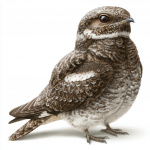
Capercaillie
Tetrao urogallus
The Capercaillie is a rare and elusive bird in Britain, primarily found in the ancient pine forests of Scotland, particularly in the Highlands, and occasionally spotted during the breeding season from April to July. It is a large and striking species, making it a prized sighting for British birdwatchers.
Field Identification Guide
Use these features to identify Capercaillie in the field.
At a glance, the Capercaillie can be identified by its dark plumage, distinctive red wattle above the eye, and a long, rounded tail, which helps to distinguish it from other grouse species.
The Capercaillie is larger than a Grey Lag Goose, making it one of the biggest grouse species in Britain.
The male Capercaillie has a glossy black plumage with a greenish sheen, a red wattle above the eye, and a white wing bar, with little seasonal variation in its appearance.
The female Capercaillie has a mottled brown plumage, providing camouflage in its forest habitat, and is similar in size to the male, but lacks the distinctive red wattle.
The Capercaillie's call is a low, guttural grunt, often described as a deep, resonant "chuck-chuck-chuck", typically heard during the breeding season.
Capercaillies are ground-dwelling birds, feeding on pine seeds, berries, and insects, and are known for their distinctive courtship displays, where males will engage in loud calling and territorial displays.
The Capercaillie can be confused with the Black Grouse, but can be distinguished by its larger size, longer tail, and the male's distinctive red wattle, as well as its more restricted range in Scotland.
Quick Facts
Who's spotted this?
Loading...
Recent community sightings
Loading recent sightings...