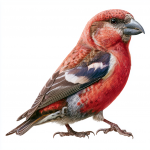
Wilson’s Warbler
Cardellina pusilla
Wilson's Warbler is a rare vagrant to western Europe, and in Britain, it is an extremely uncommon sighting, typically seen during migration periods. It can be spotted in woodland edges, gardens, and other areas with dense vegetation, although such occurrences are exceedingly rare.
Field Identification Guide
Use these features to identify Wilson’s Warbler in the field.
The species can be identified by its greenish-yellow plumage, rounded wings, and long, slim tail, with the male sporting a distinctive black crown patch. Its overall appearance is quite distinctive, making it stand out from other warblers.
Wilson's Warbler is smaller than a Starling, measuring around 10-12 cm in length, which is comparable to a Goldcrest or a Firecrest.
The male Wilson's Warbler has a bright greenish-yellow back and wings, with a yellow belly and a distinctive black crown patch on top of its head, which can vary in size depending on the subspecies.
The female Wilson's Warbler is similar to the male but often lacks the black crown patch or has a reduced version, making it slightly less distinctive than its male counterpart.
The call of the Wilson's Warbler is a sharp, high-pitched "weet" or "chip" sound, while its song is a series of rapid, musical phrases that sound like a repeated "weet-weet-weet".
Wilson's Warblers are active, insectivorous birds that forage for food in dense vegetation, often flitting between branches and flying in a rapid, darting manner as they chase after insects.
Wilson's Warbler can be confused with other yellow-green warblers, such as the Yellow Warbler or the Garden Warbler, but it can be distinguished by its distinctive black crown patch, rounded wings, and long tail, as well as its sharp, high-pitched call.
Quick Facts
Who's spotted this?
Loading...
Recent community sightings
Loading recent sightings...