Common Chiffchaff
Phylloscopus collybita
The Common Chiffchaff is a widespread and familiar warbler in Britain, typically seen from March to October, with peak sightings during spring and autumn migrations. It can be found in a variety of habitats, including woodlands, gardens, and scrublands, particularly near water sources.
Field Identification Guide
Use these features to identify Common Chiffchaff in the field.
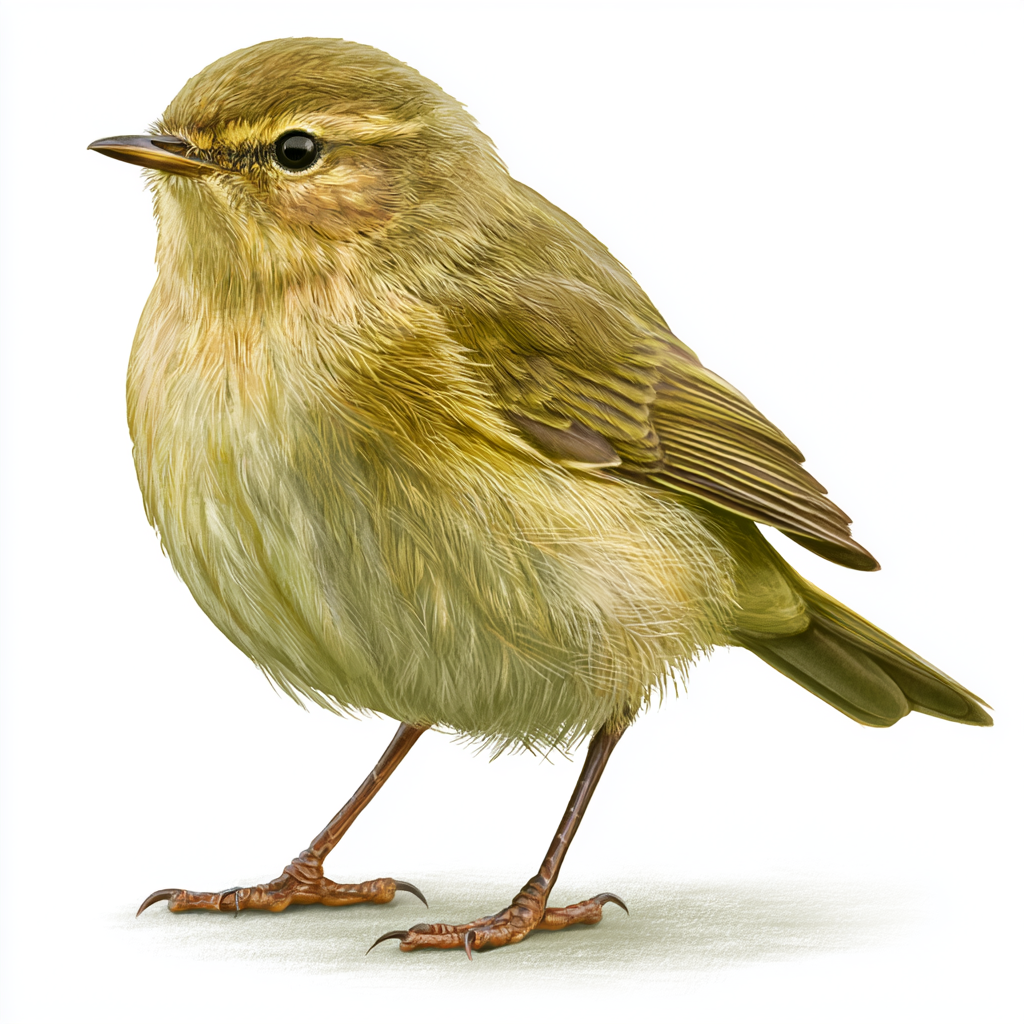
The Common Chiffchaff is distinguished by its plain greenish-brown plumage, distinctive white eye-ring, and pale yellowish-green wings and tail. Its brownish-grey legs and feet are also notable, as well as its short, pointed bill.
The Common Chiffchaff is slightly smaller than a House Sparrow, measuring around 10-12 cm in length.
The male Common Chiffchaff has a brownish-green back, wings, and tail, with a pale yellowish-green fringe on the wings and tail, and a white belly with a yellowish tint on the breast and flanks.
The female Common Chiffchaff is similar to the male, with slight variations in the intensity of the plumage colours, but overall, the sexes are alike.
The Common Chiffchaff's song is a repetitive, whistled phrase, often transcribed as "chiff-chaff-chiff-chaff", while its call is a sharp, metallic "tink" or "tick".
The Common Chiffchaff is an active and agile bird, often seen flitting between branches in search of insects, spiders, and other small invertebrates, and it has a distinctive, hovering flight style when foraging.
The Common Chiffchaff can be confused with the Willow Warbler, but it can be distinguished by its brighter, more yellowish-green plumage and its distinctive song, as well as its white eye-ring, which is less pronounced in the Willow Warbler.
Quick Facts
Who's spotted this?
Loading...
Recent community sightings
Loading recent sightings...