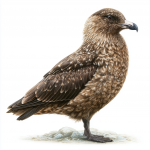
Curlew
Numenius arquata
The Curlew is a large and distinctive wader that can be seen in Britain, particularly during migration periods and in its breeding habitats in the north and west, where its haunting call is a familiar sound in wet meadows and moorlands. It is a common sight in Britain, although its numbers have been declining in recent years.
Field Identification Guide
Use these features to identify Curlew in the field.
The Curlew can be identified by its long, curved bill, brown plumage with a distinctive white stripe above the eye, and its greyish-brown wings with a white bar visible in flight. Its size and distinctive silhouette also make it a recognizable species.
The Curlew is larger than a Lapwing, with a length of around 50-60 cm, making it one of the larger waders found in Britain.
The male Curlew has a brown back and wings, with a pale brown breast and belly, and a white stripe above the eye, with little seasonal variation in its plumage.
The female Curlew is similar to the male, with no significant differences in plumage, although she may be slightly larger.
The Curlew's call is a haunting, whistled "cur-lee" or "whaup" sound, often heard at dawn and dusk, and is one of the most recognizable bird calls in Britain.
The Curlew is a ground-nesting species that feeds on a variety of invertebrates, including worms and insects, which it probes for with its long, curved bill, and is known for its swift and direct flight style.
The Curlew can be confused with other large waders, such as the Whimbrel, but can be distinguished by its larger size, longer bill, and distinctive white stripe above the eye, as well as its haunting call.
Quick Facts
Who's spotted this?
Loading...
Recent community sightings
Loading recent sightings...