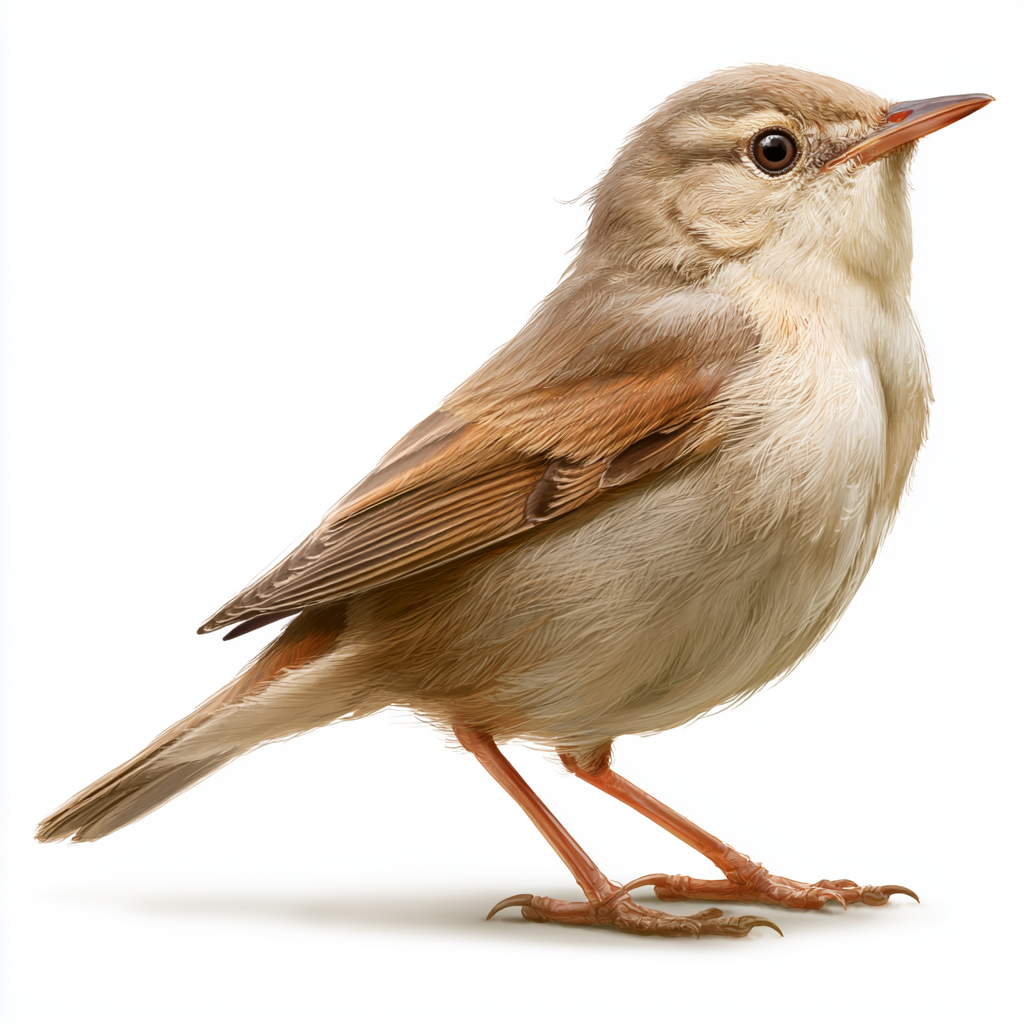
Garden Warbler
Sylvia borin
The Garden Warbler is a summer migrant to Britain, breeding in woodland edges and scrubby areas, with sightings most common from May to July and again in August and September during migration. It is a relatively common species in southern England, but less frequent in the north.
Field Identification Guide
Use these features to identify Garden Warbler in the field.
The Garden Warbler can be identified by its plain brown upperparts, dull white underparts, and lack of distinctive markings, as well as its long wings and tail. Its overall appearance is unstreaked and unpatterned, with a rounded head and a short, pointed bill.
The Garden Warbler is slightly smaller than a Blackbird, but larger than a Blue Tit, with a length of around 12-13 cm.
The male Garden Warbler has brown upperparts and dull white underparts, with no distinctive seasonal variation in its plumage, remaining relatively consistent throughout the year.
The female Garden Warbler is similar to the male, with no notable differences in plumage, making it challenging to distinguish between the sexes based on appearance alone.
The Garden Warbler's song is a rich, melodic warble, often described as similar to that of the Blackcap, with a series of whistled phrases and a distinctive, musical quality.
Garden Warblers are skulking birds, often feeding on insects and spiders in dense undergrowth, and flying with a rapid, darting motion when disturbed, with a habit of making short, frequent flights between bushes.
The Garden Warbler can be confused with other unstreaked warblers, such as the Blackcap, but can be distinguished by its lack of a distinctive cap and its more subdued, brownish colouration, as well as its song, which is similar but slightly different in tone and phraseology.
Quick Facts
Who's spotted this?
Loading...
Recent community sightings
Loading recent sightings...


