Mallard
Anas platyrhynchos
The Mallard is a common and widespread duck species in Britain, found in a variety of wetland habitats, including parks, rivers, and coastal areas, throughout the year. It is one of the most familiar and abundant waterfowl species in the UK, with a large and stable population.
Field Identification Guide
Use these features to identify Mallard in the field.
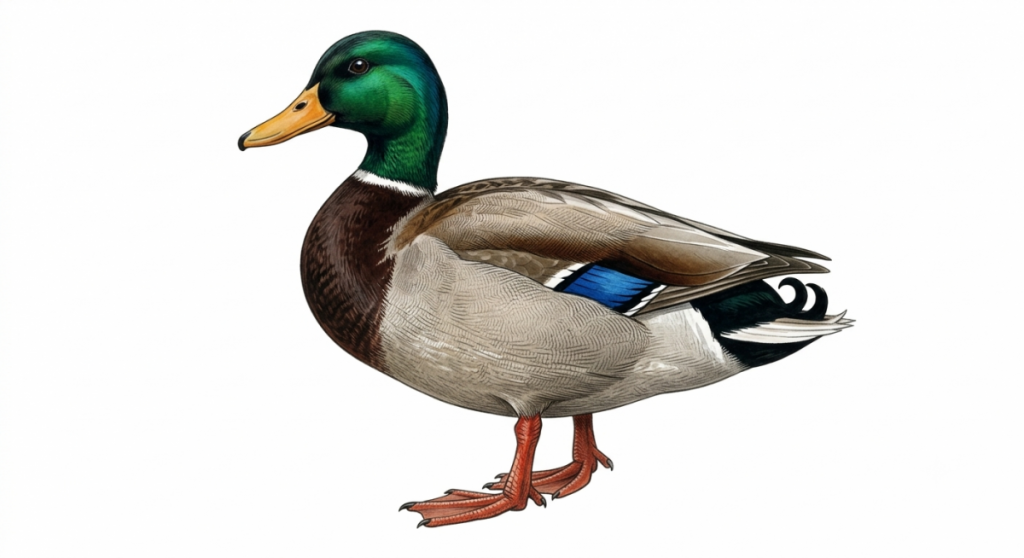
The Mallard can be identified by its bright yellow bill, distinctive green head in males, and a broad, rounded body shape, with a grey-brown back and white underside. Its wings also have a distinctive blue-purple patch, known as the speculum, which is bordered by white.
The Mallard is larger than a Blackbird, but smaller than a Goose, with a typical length of around 50-60 cm.
The male Mallard has a glossy green head, yellow bill, and a grey-brown back, with a white underside and a purple-blue speculum on its wings, which remains constant throughout the year.
The female Mallard has a more subdued plumage, with a brown head, orange-brown bill, and a mottled brown back, similar to the male's back, but without the green head and purple-blue speculum.
The Mallard's call is a loud, nasal quack, often heard from both males and females, particularly in flight or when alarmed.
Mallards are social birds that feed on a variety of plants and small animals, often dabbling in shallow water or grazing on land, and are known for their fast, direct flight style, with a steady wingbeat.
The Mallard can be confused with other dabbling ducks, such as the Gadwall or the Shoveler, but can be distinguished by its bright yellow bill, green head in males, and the distinctive speculum on its wings.
Quick Facts
Who's spotted this?
Loading...
Recent community sightings
Loading recent sightings...