Pied Wagtail
Motacilla alba
The Pied Wagtail is a common sight in Britain, particularly near water and in urban areas, with its distinctive black and white plumage making it a familiar species for many birdwatchers. It can be seen throughout the year in Britain, although some populations may migrate to Africa during the winter months.
Field Identification Guide
Use these features to identify Pied Wagtail in the field.
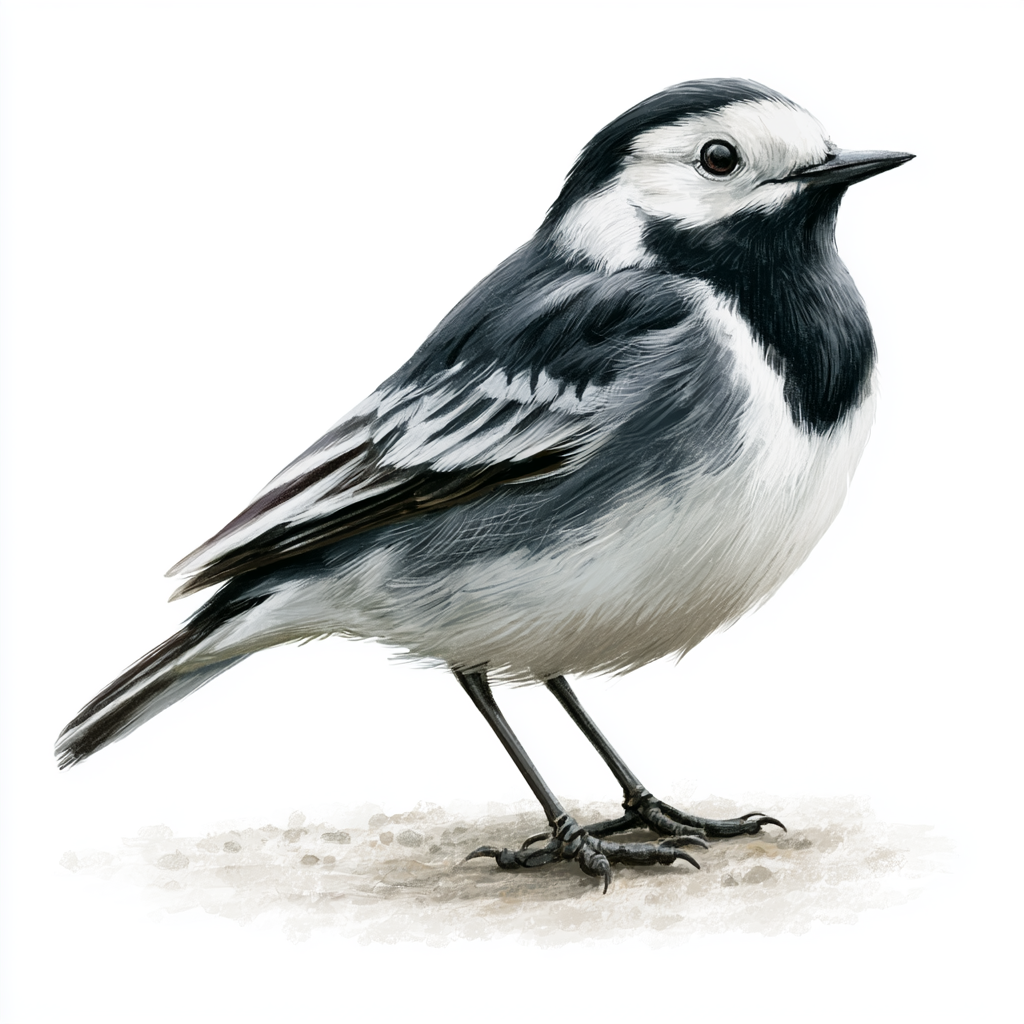
The Pied Wagtail can be identified at a glance by its black back, white underside, and distinctive white eyebrow stripe, as well as its long, black tail with white outer feathers. Its black and white colours, combined with its slender shape and constant tail-wagging motion, make it a distinctive species.
The Pied Wagtail is slightly smaller than a Starling, with a similar length but a more slender build.
The male Pied Wagtail has a black back, white underside, and a white eyebrow stripe, with a black throat patch that is often absent or reduced in winter. The male's plumage remains largely the same throughout the year, although the black throat patch may be more pronounced during the breeding season.
The female Pied Wagtail is similar to the male, although she may have a greyer or more brownish tint to her black back and a less pronounced black throat patch.
The Pied Wagtail's call is a sharp, high-pitched "chiss-chiss-chiss" or "zee-zee-zee", often repeated in a series, while its song is a more melodic series of whistled notes.
Pied Wagtails are known for their constant tail-wagging motion, as well as their habit of walking or running along the ground in search of insects and other small invertebrates to eat. They are also agile fliers, able to make sharp, rapid turns in pursuit of prey.
The Pied Wagtail can be confused with the Yellow Wagtail, which has a similar shape and size but a brighter yellow plumage and a more restricted range in Britain. The White Wagtail, which is a rare migrant to Britain, can also be similar, but it has a greyer back and a more pronounced white eyebrow stripe.
Quick Facts
Who's spotted this?
Loading...
Recent community sightings
Loading recent sightings...