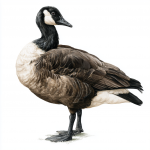
Great Black-backed Gull
Larus marinus
The Great Black-backed Gull is a common sight in Britain's coastal areas, particularly in the north and west, and can be seen throughout the year, with some populations migrating to inland lakes and reservoirs during the winter months. It is the largest gull species in Britain, making it a notable sight for birdwatchers.
Field Identification Guide
Use these features to identify Great Black-backed Gull in the field.
The Great Black-backed Gull can be identified by its white head and underparts, dark blackish-grey wings and back, and a distinctive yellow bill with a red spot. Its size and broad wings also make it a recognizable species.
The Great Black-backed Gull is larger than a Herring Gull, with adults reaching sizes comparable to a small goose.
The male Great Black-backed Gull has a white head, neck, and underparts, with dark blackish-grey wings and back, and pink legs, with the yellow bill featuring a red spot near the tip.
The female Great Black-backed Gull is similar to the male in terms of plumage, with no notable differences in colour or pattern.
The Great Black-backed Gull has a loud, harsh call that sounds like a deep, rasping "kraa" or "gaak", often used for communication and alarm.
The Great Black-backed Gull is an aggressive hunter, pirate, and scavenger, feeding on a wide range of prey including fish, crustaceans, and small birds, and is known for its powerful flight and ability to steal food from other birds.
The Great Black-backed Gull can be confused with the Lesser Black-backed Gull, but can be distinguished by its larger size, broader wings, and more pronounced white head and underparts, as well as its distinctive bill colour and pattern.
Quick Facts
Who's spotted this?
Loading...
Recent community sightings
Loading recent sightings...