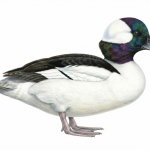
Green Heron
Butorides virescens
The Green Heron is a rare visitor to Britain, typically seen during the summer and early autumn months, often in coastal areas with abundant wetland habitats. It is a small heron native to North and Central America, and its appearances in Britain are usually considered a notable event among birdwatchers.
Field Identification Guide
Use these features to identify Green Heron in the field.
The Green Heron can be identified by its distinctive greenish-grey back, wings, and tail, as well as its dark cap and yellowish legs, with a sharp, black stripe above its eye. Its overall shape is slender and agile, with a relatively small head and a long, pointed bill.
The Green Heron is slightly smaller than a Grey Heron, but larger than a Moorhen, making it a medium-sized bird that is easily recognizable in the right habitat.
The male Green Heron has a vibrant greenish-grey plumage on its back, wings, and tail, with a chestnut-coloured neck and breast, and a dark grey cap on its head, with the colours being more intense during the breeding season.
The female Green Heron is similar to the male, with slightly less intense colours and a more subdued overall appearance, but the differences are not dramatic, and the two sexes can be difficult to tell apart.
The Green Heron's call is a sharp, shrill "skew" or "kyow" sound, often repeated in a series of two or three notes, and is usually heard during the breeding season or when the bird is alarmed.
The Green Heron is a solitary and stealthy hunter, typically feeding on small fish, frogs, and insects in shallow water, and is known for its unique habit of using bait, such as twigs or leaves, to lure prey into striking distance.
The Green Heron can be confused with the Squacco Heron or the Night Heron, but can be distinguished by its smaller size, more vibrant greenish-grey plumage, and distinctive yellowish legs, as well as its sharp, black stripe above its eye.
Quick Facts
Who's spotted this?
Loading...
Recent community sightings
Loading recent sightings...