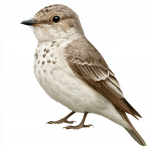
Little Gull
Hydrocoloeus minutus
The Little Gull is a rare but regular migrant to Britain, typically seen during the summer months, particularly in the eastern and southern regions, often near freshwater lakes and marshes. It can also be spotted during its passage to and from its breeding grounds, usually in small numbers.
Field Identification Guide
Use these features to identify Little Gull in the field.
The Little Gull can be identified by its small size, dark hood during breeding season, and white wing tips, as well as its distinctive blackish-brown bar on the wings. Its slender bill and rounded wing tips are also notable features.
The Little Gull is smaller than a Black-headed Gull, roughly comparable in size to a large tern, such as the Common Tern.
The male Little Gull has a dark grey-black hood during the breeding season, which contrasts with its pale grey back and white underside, with a distinctive blackish-brown bar on the wings.
The female Little Gull is similar to the male, with a slightly less intense hood colouration during the breeding season.
The Little Gull's call is a high-pitched, sharp "kek" or "kik" sound, often repeated in a series of short phrases.
The Little Gull is an agile and nimble flyer, often seen hovering or diving for small fish and insects, and it tends to feed in small, loose groups, frequently over freshwater or coastal areas.
The Little Gull can be confused with the Black-headed Gull, but it is distinguished by its smaller size, darker hood, and lack of a white leading edge to the wings, as well as its more slender bill and different wing shape.
Quick Facts
Who's spotted this?
Loading...
Recent community sightings
Loading recent sightings...