American Coot
Fulica americana
The American Coot is a rare visitor to Britain, typically seen near wetlands and open water bodies during migration periods, with most sightings occurring in the autumn and winter months. It is most often spotted in southern and western regions of the country, particularly in areas with abundant aquatic vegetation.
Field Identification Guide
Use these features to identify American Coot in the field.
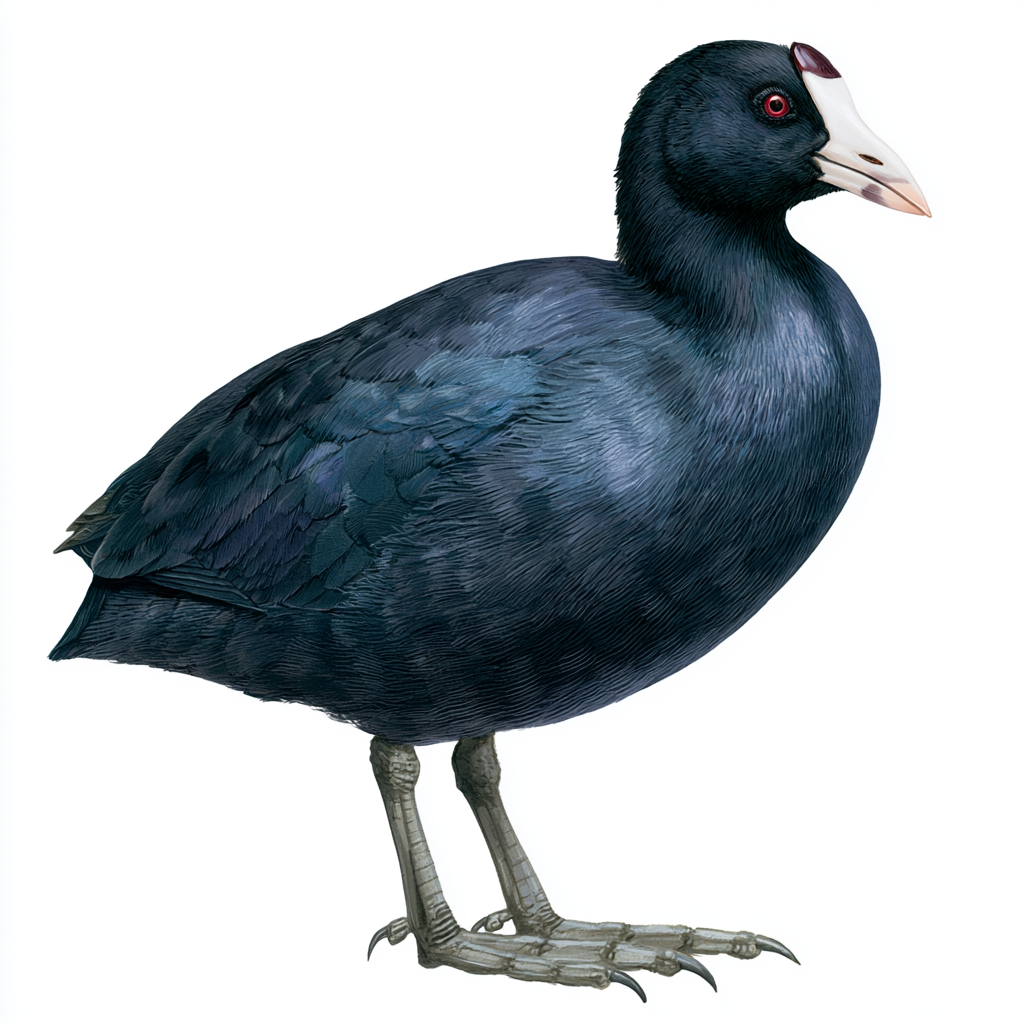
The American Coot can be identified by its black head, white bill, and distinctive lobed scales on its lower legs and toes, as well as its greyish-brown body and white underside. Its relatively small head and long, greenish-yellow legs are also notable features.
The American Coot is slightly larger than a Moorhen, with a more compact body, and is generally around 35-40 cm in length.
The male American Coot has a glossy black head, neck, and breast, with a greyish-brown back and wings, and a white belly, with no significant seasonal variation in its plumage.
The female American Coot is similar to the male, with the same overall pattern and colouration, although she may appear slightly duller in tone.
The American Coot's call is a loud, high-pitched "kruk" or "kuk", often repeated in a series of sharp, nasal notes.
American Coots are omnivorous birds that feed on a variety of aquatic plants, insects, and small animals, often diving or foraging in shallow water, and are known for their distinctive, energetic swimming style and erratic flight pattern.
The American Coot can be confused with the Eurasian Coot, but can be distinguished by its white bill and more subdued colouration, as well as its lobed scales on its lower legs and toes, which are more pronounced than those of the Eurasian Coot.
Quick Facts
Who's spotted this?
Loading...
Recent community sightings
Loading recent sightings...