Olive-backed Pipit
Anthus hodgsoni
The Olive-backed Pipit is a rare migrant to Britain, typically seen during the autumn and winter months, with sightings mostly confined to the eastern and southern coasts. It is more commonly associated with its breeding grounds in southern and eastern Asia, and its wintering grounds in southern Asia and Indonesia.
Field Identification Guide
Use these features to identify Olive-backed Pipit in the field.
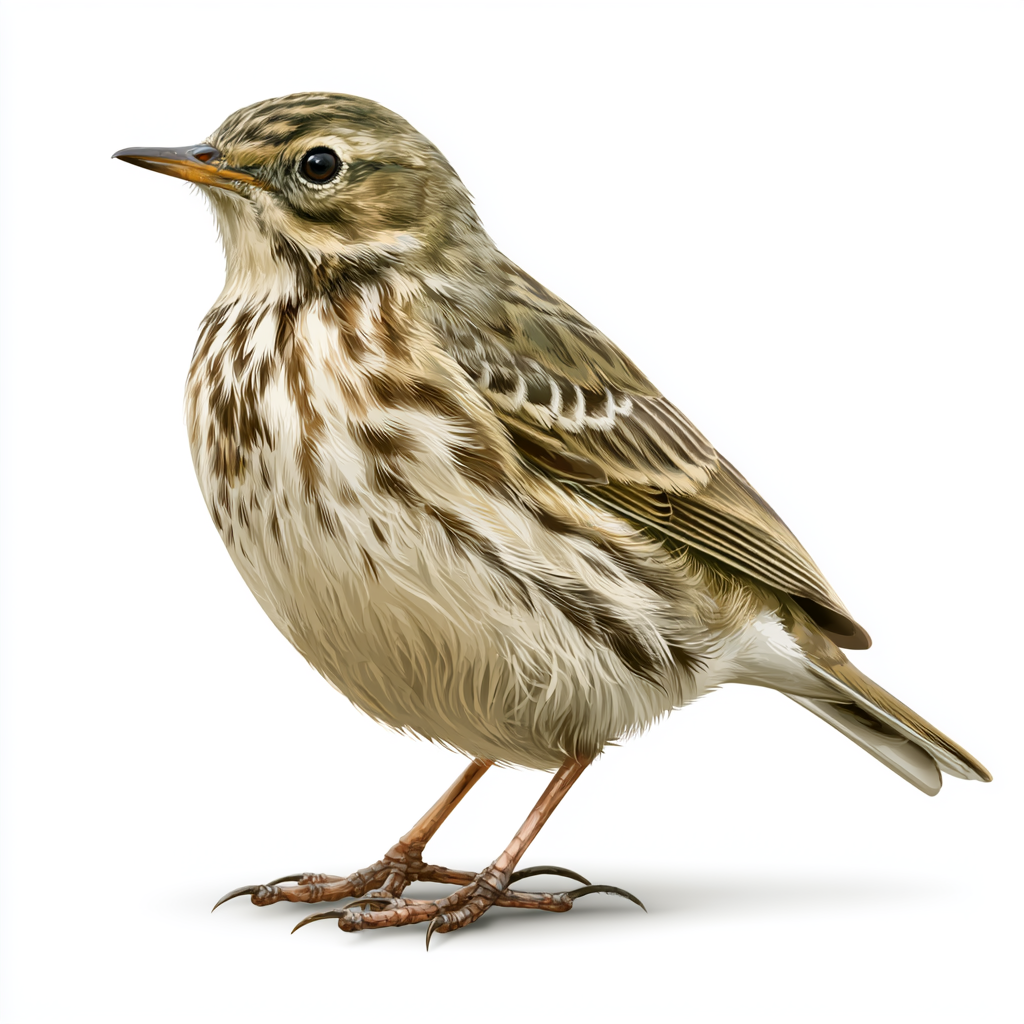
The Olive-backed Pipit can be identified by its olive-toned back, less streaked than similar species, a well-marked supercilium, and a distinctive head pattern. Its overall appearance is also characterized by a slender build and a long tail.
The Olive-backed Pipit is slightly smaller than a Meadow Pipit, and larger than a Blue Tit.
The male Olive-backed Pipit has a brownish-olive back, wings, and tail, with a pale brown breast and belly, and a distinctive white supercilium, with minimal seasonal variation in its plumage.
The female Olive-backed Pipit is similar to the male, with slight variations in the intensity of the olive tone on its back, but overall, the female's plumage is nearly indistinguishable from that of the male.
The Olive-backed Pipit's call is a sharp, high-pitched "tzeep" or "tsip", often repeated in a series, while its song is a melodious, warbling phrase, typically heard during the breeding season.
The Olive-backed Pipit is a ground-dwelling bird that forages for insects, seeds, and fruits, often running or walking on the ground with a distinctive gait, and when in flight, it has a swift, direct trajectory with rapid wingbeats.
The Olive-backed Pipit can be confused with the Tree Pipit, but it can be distinguished by its more olive-toned back, less streaked breast, and a better-marked supercilium, as well as its different head pattern and overall build.
Quick Facts
Who's spotted this?
Loading...
Recent community sightings
Loading recent sightings...