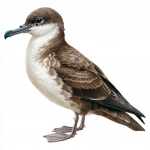
Wilson’s Storm Petrel
Oceanites oceanicus
Wilson's Storm Petrel is a rare but occasional visitor to British waters, typically seen during the summer months in the northern hemisphere, particularly in the Atlantic Ocean to the west of the UK. It can be spotted from coastal headlands or on pelagic trips, although sightings are generally infrequent and often associated with stormy weather.
Field Identification Guide
Use these features to identify Wilson’s Storm Petrel in the field.
This species can be identified by its small size, square-shaped tail, and distinctive white rump patch, as well as its rapid, fluttering wingbeats and low flight over the water. Its brownish-grey plumage and pale wing bars are also notable features.
Wilson's Storm Petrel is smaller than a Starling, measuring around 19-21 cm in length, and is one of the smallest seabirds to occur in British waters.
The male Wilson's Storm Petrel has a uniform brownish-grey plumage with a pale wing bar and a white rump patch, with no significant seasonal variation in its appearance.
The female Wilson's Storm Petrel is similar to the male, with no discernible difference in plumage.
The call of Wilson's Storm Petrel is a high-pitched, chirping or chattering sound, often described as a series of sharp, staccato notes.
Wilson's Storm Petrels are highly pelagic, spending most of their time at sea, where they feed on small crustaceans, fish, and plankton, often in association with other seabirds and marine mammals. They have a characteristic flight style, with rapid, fluttering wingbeats and a low, gliding flight over the water's surface.
Wilson's Storm Petrel can be confused with other small storm petrels, such as the European Storm Petrel, but can be distinguished by its larger size, square-shaped tail, and distinctive white rump patch, as well as its more rapid and fluttering wingbeats.
Quick Facts
Who's spotted this?
Loading...
Recent community sightings
Loading recent sightings...