Red-crested Pochard
Netta rufina
The Red-crested Pochard is a rare but striking visitor to Britain, typically seen during migration periods or as a wintering species in southern regions. It can be spotted in lowland marshes, lakes, and coastal wetlands, often in small flocks.
Field Identification Guide
Use these features to identify Red-crested Pochard in the field.
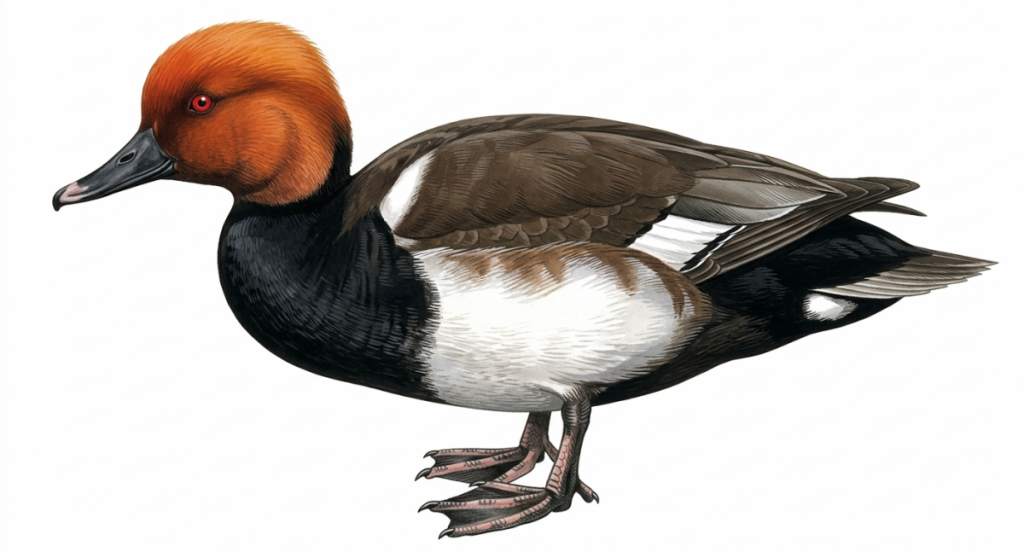
At a glance, the Red-crested Pochard can be identified by its bright orange-red head, greyish-brown body, and distinctive black neck and breast markings. Its rounded head and steep forehead are also notable features.
The Red-crested Pochard is larger than a Mallard, with a similar size to a small goose.
The male Red-crested Pochard has a vibrant orange-red crest on its head, with a greyish-brown back, black neck and breast, and pale grey flanks, with little seasonal variation in its plumage.
The female Red-crested Pochard has a similar but duller plumage to the male, with a brownish-grey head and body, and less distinct black neck and breast markings.
The Red-crested Pochard has a low, growling call, often described as a deep "krrr" or "krek" sound.
Red-crested Pochards are diving ducks, feeding on aquatic plants, insects, and small invertebrates, and can be seen swimming and foraging in shallow waters, often with their heads submerged.
The Red-crested Pochard can be confused with other pochard species, such as the Common Pochard, but can be distinguished by its bright orange-red head and distinctive black neck and breast markings.
Quick Facts
Who's spotted this?
Loading...
Recent community sightings
Loading recent sightings...